


Respect, the theory of everything
FEATURE – Respect is Lean's generative principle. The author maps how it radiates toward self, team, customers, suppliers, society — separating real transformation from mere deference.
Words: Matteo Consagra
As humans, we are drawn to unifying ideas — single principles that bring order to complexity. Stephen Hawking, for example, spent decades searching for one in physics: a theory capable of reconciling gravity, electromagnetism, and nuclear forces into a single coherent framework. He never found it. Philosophers and ethicists have been luckier: the golden rule (treat others as you wish to be treated) appears in virtually every moral tradition across human history, a rare example of a principle so fundamental it transcends culture, religion, and era.
In Lean, such a unifying principle also exists. It is the root from which all lean tools, all lean methodology, and the entire philosophy of continuous improvement grow. It is called respect. It’s not a decorative value to hang on company walls. It is not courtesy, diplomacy, or social harmony. Respect — in its most demanding sense — is the generative principle from which all other elements of a genuine transformation derive. The Toyota Way 2001, in its entirety, is driven by this. Every tool, every practice, every lean behavior is, at its root, an act of respect toward someone or something.
It took me years to understand this with such clarity.
RESPECT DOES NOT MEAN “PEACE AND LOVE”
Before going further, it is necessary to clarify what respect is not. It is not giving in. It is not avoiding conflict. It is not approving everything people do or want.
True respect means making difficult decisions when values demand it — even when it is uncomfortable, even when it costs something, even when someone disagrees. A CEO who avoids a difficult decision to prevent tension is not respecting anyone: he is only respecting his own comfort.
This distinction is fundamental because the CEOs who fail at lean transformations often perceive themselves as respectful — open, available, attentive to people. But respect without courage is not respect. It is deference. And deference transforms no organization.
WHO RESPECTS WHOM: THE COMPLETE MAP
The respect of a CEO who is truly ready to lead a lean transformation is not directional: it does not flow only upward or only downward. It radiates in all directions simultaneously. This is what makes it recognizable, and difficult to simulate.
Respect toward oneself and toward the role
A CEO respects themselves when they know their own limits, when they do not claim to have all the answers, when they do their homework between one meeting and the next. They respect their role when they understand that their function is not to do — it is to create the conditions that allow others to perform better than they could. Those who lack this respect walk into every room convinced they already know how things will turn out. They do not learn. They do not change. And the transformation stops wherever they stop.
This respect begins with a clear boundary: the CEO's area of responsibility must be explicit. Defining and communicating the company’s strategic direction and building the company culture are tasks that flow directly from their role. The most striking example I have encountered involves a company where owner and CEO were the same person. The company had strong financial performance but struggled to grow. After initial alignment discussions, the owner-CEO began working consistently to remove the constraints and obstacles to realizing the strategy agreed upon with the rest of the organization, setting the construction of a continuous improvement culture as his primary objective — to the point of incorporating the phrase "Going beyond limits" into the company's purpose.
Respect toward team members, the CEO's first customers
Team members are the CEO's first customers. They expect the best possible decisions from whoever runs the organization, because their ability to bring home a paycheck each month, safely and with satisfaction, depends on those decisions. A CEO who respects their team members builds the best possible environment in which to work (cleanliness, ergonomics, reduction of unnecessary fatigue and difficulty, and so on). They help people become better than they were at the start of the journey. They encourage people to grow, rather than seeing them as resources to be optimized.
In a company I have worked with for several years, the CEO almost never provided solutions when problems outside his direct responsibility were brought to him — even for important matters. As counterintuitive as it may seem, it is the most respectful way to treat another person: answering directly is implicitly saying, “let me tell you how it's done, because you can't figure it out on your own.” At the beginning, the temptation to provide solutions was strong (the brain craves the dopamine that comes from solving a problem). But his ability to resist that urge paid off in the long term: today his team members come to meetings with data, facts, and alternatives, and discussion focuses solely on the reasoning behind them. Consistent with the respect for his own role, this CEO expects the same principle to be applied by those who work with him.
Respect toward external customers
Respect for customers translates into a genuine drive to evolve and innovate products and services with the real customer as the reference point — not as a pretext. Profit is not the objective, but the result of having respected the customer enough to earn their trust over time. A CEO who uses Lean to cut internal costs without ever asking whether the customer perceives more value has understood nothing about Lean, and has probably understood nothing about respect.
A company I work with put its entire product development roadmap, organization, and governance model into question, in order to become more proactive in identifying the unmet needs of its market. The result was a radical shift in pace, at the cost of freezing several projects that had proved too focused on internal priorities.
Respect toward suppliers
A supplier is not a lemon to be squeezed dry and discarded. It is one of the cornerstones of a solid supply chain — and therefore of reliable, sustainable service to the customer over time. Treating a supplier as a cost variable to minimize rather than a relationship to develop produces fragility along the entire chain. This applies to coaches as well, who are suppliers in every sense: a CEO who treats them in a patronizing way develops managers who treat suppliers in the same way. Behaviors at the top propagate downward. Respect is either systemic or it is nothing.
Several companies I work with demonstrate this in practice: at their own expense, they have connected me with their suppliers to help them evolve toward a higher level of service. And some of them are building genuine partnerships, including equity stakes, to grow together with their suppliers rather than at their expense.
Respect toward the environment and institutions
Complying with laws and regulations is not a constraint — it is one of the fundamentals. A CEO who aspires to achieve a genuine lean transformation goes further: they ask what positive mark they leave on society, on the environment, on the territory in which they operate. This is not idealism; it is a form of long-term thinking that Lean has always recognized and practiced.
Among the companies I work with, steps in this direction are becoming increasingly common, from collaboration with local government to revitalize areas around the plant to dedicated budgets to support associations working with people with disabilities.
THREE SIGNS TO RECOGNIZE THOSE WHO LACK RESPECT
Over the years, I have learned to recognize the absence of respect from three specific behaviors, which appear almost invariably in CEOs whose transformations never gain traction.
The first is deciding based on gut feeling, without nemawashi. These CEOs make important decisions without communication, sharing, or the necessary consensus-building. Then they are surprised that the organization does not follow. But decisions handed down from above, however correct in theory, do not build capability. They build dependency, which is the opposite of what a lean transformation requires.
The second behavior is not making any decisions at all, with the organization suffering at every level — problems remain unresolved, people wait, energy dissipates. Indecision is not caution; it is a form of disrespect toward those who depend on that decision to do their work.
The third behavior, which is also the most insidious, is believing you already know all the answers and not doing your homework. These CEOs participate in training and coaching sessions with their minds already closed. They do not experiment. They do not bring real problems. They do not change their behavior from one meeting to the next. They are not trying to learn, just to confirm what they already think. Unfortunately, a lean transformation cannot take place inside a mind that has no room for new knowledge.
WHEN RESPECT TRULY REVEALS ITSELF
Declaring respect is easy. Showing respect in moments of tension is another matter entirely. I have seen CEOs who embodied all the right values, until a difficult moment arrived — a market crisis, a negative quarter, a significant internal conflict. That’s when respect reveals itself, or not. In a moment of tension, the first temptation is the opportunistic decision: the one that solves the immediate problem but betrays the values and direction the organization has been working toward. Those who yield to that temptation do not lose respect in that moment — they had lost it long before. The difficulty simply made it visible.
The most striking example I have personally witnessed involved a company well advanced in their lean transformation, whose CEO — in a moment of severe market pressure — decided to take on the interim roles of both commercial director and head of purchasing. The result was an abrupt halt to the transformation. It is easy to see why. By simultaneously filling multiple roles, the CEO immediately undermines respect for their team members, who find themselves stripped of their responsibilities. At the same time, respect for the CEO’s own role erodes, and the CEO becomes a bottleneck — further slowing down the recovery from the crisis instead of accelerating it.
Another revealing moment is when things are going well. Lean requires a permanent tension toward improvement — not only when there is a problem to solve, but especially when everything seems to be working. CEOs who lose that tension in moments of success are those who confuse the result with the journey. Respect for the organization means not letting one's guard down when you are winning. It means continuing to ask what can be done better, even when no one is asking you to.
Respect is not what a CEO declares. It is what survives the moment it becomes expensive.
THE AUTHOR

Read more


VIDEO - Dan Jones was one of the keynote speakers at this year's Lean Summit in The Netherlands. Here's a 15-minute excerpt of his talk, with some great insights into the state of lean thinking.

FEATURE – Construction is rife with waste, and yet lean is not widely adopted in the industry. The authors highlight how lean could benefit the sector, emphasizing the importance of developing problem-solving capabilities.
PROFILE – In this new section, Planet Lean features some of the most inspirational lean leaders out there. For the first profile, we have selected James Hereford, a former high school teacher who is now leading his third healthcare transformation.
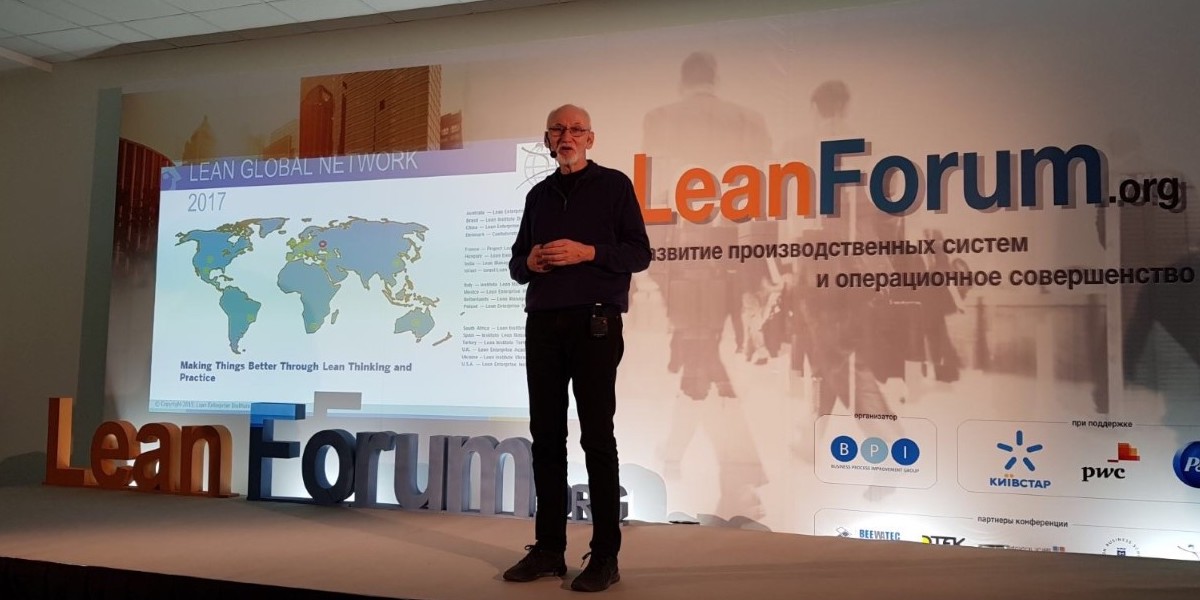
FEATURE – As the senseless war in Ukraine continues, the author looks back to his visit to the country in 2017, recalling and celebrating its vibrant lean community.
Read more

ROUNDUP – Our editor reflects on the all-important lean concept of “respect for people” and shares some of the best content published by Planet Lean on the subject.
FEATURE - Mission creep, silos and a disengaged workforce are some of the negative effects of traditional management. Michael Ballé offers an alternative based on the respect for people principle of lean thinking.

FEATURE – The authors share the main insights from a webinar with two Toyota leaders from South America, on the leadership practices that have allowed the company to sustain results for decades.
ARTICLE - We always talk about going to the gemba, but we often don't understand what that entails and what changes it can bring to our companies. In this article, we hear about the experience of Thales.