


Reinventing automotive logistics with Lean
NOTES FROM THE GEMBA – In Part 1 of this mini-series on Aramisauto, the author explores how the company transformed its supply chain through pull flow, daily management, and problem solving.
Words: Catherine Chabiron
The European automotive market is under pressure and still struggling to return to pre-Covid sales levels. This is particularly true in France, where manufacturers and brand dealerships are merging or seeking other sources of revenue, such as used car sales, after-sales service or financing services.
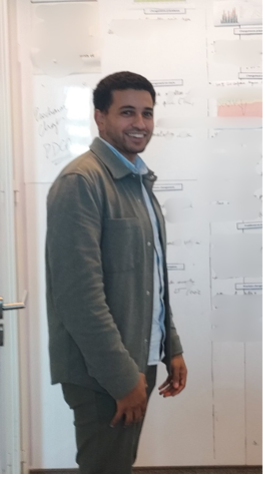
I meet today with Zakaria Bouzekri, Aramisauto's supply chain director, and Gaëtan Wagnies, his deputy. The mood at Aramisauto today is serious but not gloomy: Aramisauto is posting double-digit revenue growth for the financial year just ending, in a difficult automotive French market.
"The post-Covid period and the difficulties facing the automotive sector have forced us to streamline our projects, but the deal was clear with the teams: we would maintain jobs and, in exchange, everyone would work on 'cutting waste' and help out where needed. The turnaround has been spectacular." - Romain Boscher, MD of Aramisauto France

Aramisauto sells zero-km vehicles (the definition of a new vehicle in France is strict: it has never been driven and is not yet registered. Aramisauto sells vehicles that are already registered with very low or even zero mileage) and reconditioned used cars, online and through its 36 branches in France. My last visit to Aramisauto in September 2017 already mentioned their supply chain management: they were then starting their first experience with pull flow. I wonder how Aramisauto's supply chain is doing today, and what they have learned over the last decade.
SIMPLIFY CUSTOMER’S EXPERIENCE – A REAL CHALLENGE FOR THE SUPPLY CHAIN
Let’s take a quick look back at the offering that Aramisauto’s supply chain has to support. Aramisauto seeks to simplify the car-buying experience, which is either cumbersome and risky (when using classified ads) or limited in choice, with prices to be negotiated (when buying at dealerships). Through its website, it offers a single point of contact for purchasing and financing a vehicle, a wide range of low-mileage and used vehicles from multiple brands (more than 2,700 vehicles across 35 brands) with technical descriptions, photos and comparison tools, and a pre-negotiated price. Delivery can be made to your home or to one of 36 branches. It is this flow of vehicles that the supply chain must manage.
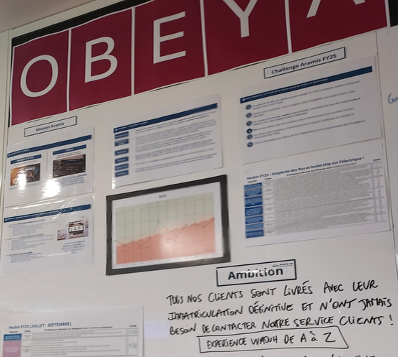
We arrive at the company’s Obeya and Zakaria describes the challenge to me: “The supply chain has to transport a vehicle from point A, where it was purchased, to point B, where it is delivered. Point B is as close as possible to the customer, if not their home. The vehicle is registered, all documents ready, and, if it is a used one, reconditioned. Zero problem for the customer.” Aramisauto now has two reconditioning plants in France, through which all purchased used vehicles pass.
THE PULL FLOW FREED UP CASH AND OPENED NEW OPPORTUNITIES FOR EXPANSION
Excess vehicle stock is costly. By 2018, Aramisauto's Chief Financial Officer estimated that the pull flow had freed up €10 million in cash in the circuit. Pull flow started at the agencies (downstream flow) by organizing areas in the car parks where anomalies or discrepancies could be identified, then using the delivery appointment date set with the customer as the trigger for transport: the logistics team will deliver the vehicle one day before the set date.

Zakaria, Gaëtan and Asmaa, who is the team leader of the Logistics team, experienced it first-hand. Zakaria sums it up very well: “To organize the pull flow in the branch, we had to negotiate directly with the truck drivers, one by one. We set up a specific appointment for each driver. They really liked this because they like to drive, not wait. As a result, we were able to negotiate with them so that their loading or unloading time would not exceed one hour. The Donzère reconditioning plant stopped preparing batches of cars to be loaded and delivered in advance. The preparation of batches is now triggered by the pull flow from the agencies.”
Gaëtan agrees: “It was a revelation at the time. We thought we were behind schedule with new vehicles, but in fact 20% of vehicles arrived more than a fortnight early. 25% of the stock in the dealerships was not deliverable because it had not yet been registered. We were pushing vehicles to the dealerships to optimise truck fill rates, and the car parks were overflowing...”
"The big change is being able to see the companyas a flow of value to the customer, rather than a series of organisational silos." - Romain Boscher

An interesting result: pull flow confirmed that branches could operate with smaller car parks, which made it possible to set up shop in smaller spaces closer to customer needs.
ON-TIME DELIVERY DRIVES LEARNING ABOUT THE CUSTOMER EXPERIENCE
We look at the On-Time Delivery (OTD) chart in the Obeya: “On-Time Delivery means delivering on time, for example at the time agreed with the customer when the order was placed,” explains Zakaria. “But it also means being 100% compliant, no errors on the vehicle, with the vehicle registration document available and the permanent number plate in place.”
OTD, which was stagnating at around 60% in push flow, has improved significantly. “From a logistical point of view (meaning the ability to get the vehicle to the agency’s car park on time for the delivery appointment), we are at nearly 95%,” Gaëtan explains. “We are working closely with the agencies on the remaining issues, whether they concern difficulties in obtaining payment of the balance, vehicle quality or other matters.”
“We want to focus on OTD, aka delivery compliance,” says Zakaria. “When we work on quality, we generally see improvements in lead-times (and costs). In a highly competitive market like ours, we have no choice but to continue to identify and address our waste.”

Years of co-piloting and gemba with Regional Directors and Agency Managers have taught them one thing: it is difficult for salespeople to keep the initial appointment set with the customer. Gaëtan nods: “Each customer is an individual case, and we have to help them all. For example, we have discovered that we need to acquire new skills on each of the banks likely to finance a car loan, as their processes and controls are different. Agencies that have mastered these skills have a better level of on-time delivery than others. But we are also on the lookout for other factors in our gemba: the agency’s ability to manage variability in demand, training new staff, etc.”
Another learning factor: Aramisauto now offers a Prime delivery system (24-hour delivery) similar to Amazon’s, a clear differentiator in the automotive market since the agency can request a Prime delivery of any available vehicle, wherever it is, until 3 p.m. the day before. Offering Prime delivery within 24 hours requires trust. The logistics department has to communicate, go out into the field to be as close as possible to the problems, and support and assist sales staff.
I ask Zakaria and Gaëtan how often they go out into the field: “We have a visit schedule,” Zakaria says, smiling. “Once a month to our reconditioning plants, and one of the 36 agencies every five weeks.”
MAINTAINING SAFETY, QUALITY, DEADLINES AND COSTS ON A DAILY BASIS
Asmaa, Logistics team leader, is leading the Logistics team’s daily meeting. Logistics manages everything related to Transport and Storage and seeks to improve OTD and delivery lead-times. “The team really looks forward to this ritual,” says Gaëtan. “They need it to decide on certain issues, get help, talk about their problems, and get a feel for the day ahead.”
The meeting is very intense, covering issues such as bottlenecks, safety (winter salting equipment for the factory), quality (a supplier unable to give a deadline for resolving a quality issue with a purchased vehicle), lead-time (management of more than ten days’ delays), costs (empty truck returns), alerts (the Montpellier agency car park is overflowing with vehicles, who is taking care of it?).
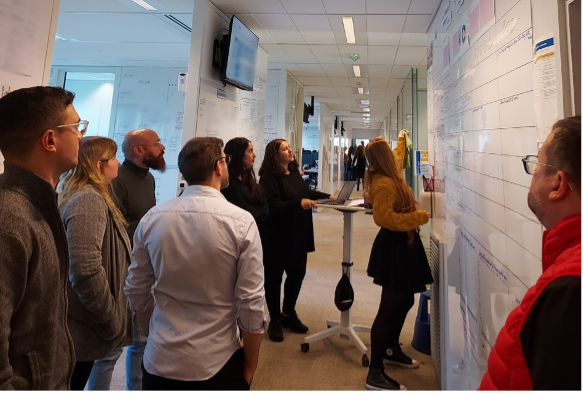
The daily meeting is not a time for reflection nor problem solving, but rather a time to hammer home the meaning of what the team does (safety, quality, deadlines, costs), alert people to problems and check who is helping whom with what, or even find a consensus on an option for dealing with a difficult case. Areas of tension are identified and visualized, either in the form of indicators or via screens showing, for example, the status of agency stocks.
Each new problem is subject to problem solving:
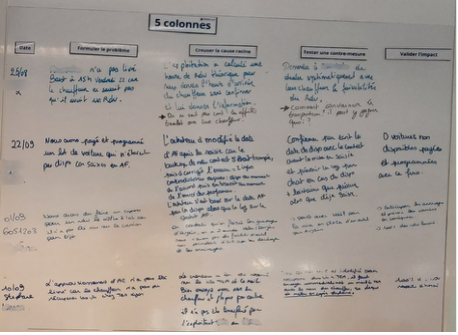
These are often specific issues, such as this loading error on a Peugeot 208: three Peugeot 208s of the same colour were stored at the supplier's premises that day, the chassis number was not checked, and the wrong vehicle was loaded. Or a lorry with an empty space, because it has to pick up an additional vehicle elsewhere: a local decision is made to fill it to optimize transport, without checking whether the slot is actually available on the transport document.
Special cases are always revealing: ambiguity about roles, a misunderstood standard, inadequate training, an unsuitable IT system, etc. Once a month, one of the problems is selected to ensure that the countermeasures taken are effective and to confirm any new points of knowledge to be shared.
"It is very important to evaluate and improve thequality of problem solving. Respect for employees means that we expect highstandards, because we know they have the potential to do it." - Romain Boscher
The daily meeting is not the only meeting point. In another corridor, I see Vincent, managing the second Supply Chain team, in charge of all administrative processes (used vehicle trade-ins, supplier documentation, registration). He is starting a different kind of stand-up meeting, this time a weekly one, with one of the three team leaders, in front of their Obeya wall. The stated ambition is clear: to reduce the number of customer calls about registration issues, each of which is a sign of a right-first-time failure. This one-on-one meeting will allow them to go into detail about the problems for an hour, in a calm atmosphere.
"There is a direct correlation between customerNPS and employee NPS. When customer satisfaction drops, employees have to dealwith failures, rework and calls, and that's no fun for anyone. Working toreduce calls kills two birds with one stone." - Romain Boscher
REDUCING VARIABILITY TO SMOOTH OUT THE EFFORT
“Variability is everywhere in the flow, upstream and downstream,” Zakaria explains. “It’s a challenge for reconditioning plants, for customers, and for the team that experiences peaks in activity. We are constantly looking for ways to mitigate the impact of this variability.”
Customers are private individuals, and given the importance of the purchase for them, 45% of them request delivery on Fridays or Saturdays, which creates a peak at the agency parks. The trade-in of used vehicles follows the same logic. Prime Sales (24-hour delivery) also contribute to un-level the workload throughout the week.
“We have learned to track our trucks hour by hour, rather than day by day,” explains Zakaria. “We ask ourselves the right questions so as not to waste time or put the teams in difficulty. We had to strengthen our relationship with our transport partners, as Prime involves night-time transport. We also learned to use MIFA (Materials Information and Flow Analysis) to identify points in the flow where we had high variability and wasteful mileage that needed to be eliminated, in order to deliver as quickly as possible.”
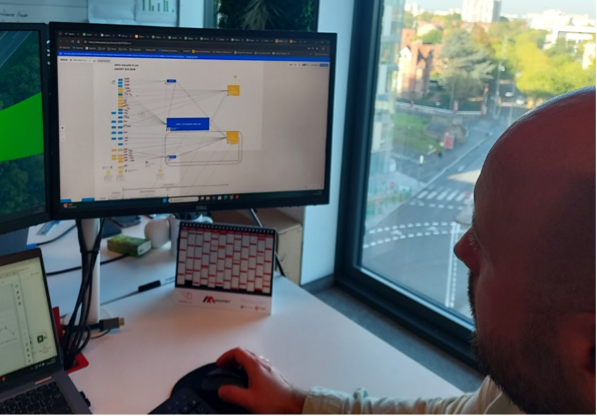
"MIFA is a key management tool: we need toconstantly understand the flow to the customer and our weak points. MIFA forcesus to go out into the field to get into the details and understand the impactof our choices." - Romain Boscher
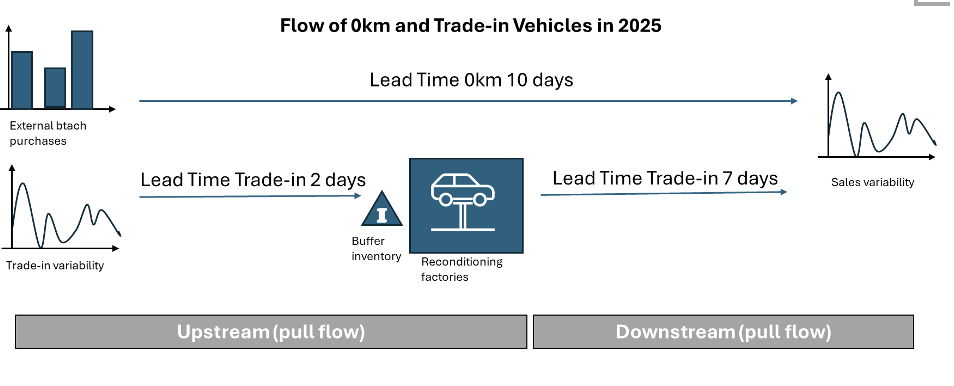
Since 2018, they have continued to improve the flow step by step. They are reducing intermediate stocks, positioning buffer stocks at the factory entrance so that factories do not suffer the full brunt of batch purchases and considering reception times with agencies. Gaëtan, who recently did a gemba at the Cannes agency, has an example in mind: “The agency had initially planned to add an extra person on Saturdays to adjust resources to demand, as the influx is so high at the weekend,” he explains, “but that didn’t solve the problem of saturation in the car park or the extra effort required of transporters on Thursdays and Fridays. A trial was therefore launched to see if customers could be attracted by extending the agency’s opening hours on Wednesdays and Thursdays until 8.30 PM.”
PREPARING FOR THE MEDIUM AND LONG TERM, INNOVATING
“The further we go, the more precise we have to be in the face of uncertainty,” Zakaria tells me. The vision he promotes for the supply chain is displayed on the wall: “Anticipate future needs with our teams and partners to grow our supply chain sustainably every day.”
How can we stay ahead? How can we see things before others do? How can we innovate while guaranteeing delivery quality, reducing lead-times, costs and environmental footprint, without jeopardizing the safety of our teams?
There are many areas for reflection and collaboration. In terms of quality, for example, trade-in cars have higher mileage, making reconditioning more complex, with greater variability from one vehicle to another. The arrival of electric vehicles requires new skills in the factory. It also impacts transport capacity, as the batteries in electric vehicles make them heavier. Transport itself is affected by the increasing age of drivers and recruitment difficulties. “Moreover, how can we be as accurate as possible in terms of mileage, the number of movements between one point and another, and optimize the fill rate to reduce costs and carbon impact?” says Gaëtan, showing me his CO2 emissions indicator.
“We also need to work on the entire supply chain to support Business-to-Consumer growth,” adds Zakaria, “and even develop new PC&L (Production Control & Logistics) roles to manage it, without compromising on quality.”
Be precise, collaborate, develop partnerships, get it right the first time, always do better. The lead-times the Aramisauto teams show me speak for themselves: for new vehicles, the lead-time between order and customer delivery has gone from 20 days in 2018 to 10 today. For used vehicles, it has gone from 17 days to 9. This improvement has been achieved through both individual and collective efforts, forging a close-knit network of relationships between headquarters, agencies, transporters and reconditioning plants. We can bet that Aramisauto's supply chain will continue to grow, in every sense of the word.
Come back next month for Part 2!
THE AUTHOR

Read more


FEATURE – BRQ Digital Solutions shows that effective customer-focused improvement must happen from the inside out, with team development aligned with the pillars of lean digital transformation.
FEATURE – The theory of hoshin kanri is clear, but how can you adapt it to a government organization structured in departments where making A3s is not a daily practice? A Dutch ministry shares its experience.
FEATURE – The Continuous Improvements Boards at the Round Mountain mining site have been critical to shifting the company's culture... the secret, it turns out, is always providing feedback on people's suggestions.

INTERVIEW – What is the secret to Toyota’s ability to engage people in continuous improvement? Tracey and Ernie Richardson look back at their time with the company and tell us.
Read more
NOTES FROM THE GEMBA – Catherine’s gemba walks are back after the summer break. This month, she visits a start-up that is using lean to manage its growth, and learns about its management’s extraordinary turnaround.

NOTES FROM THE GEMBA - Two French firms, AIO and Proditec, illustrate how Lean Thinking endures through crises by deliberately developing a new generation of leaders who sustain its culture and intent.

NOTES FROM THE GEMBA – Somfy’s R&D department is applying Lean Thinking to close knowledge gaps, improve collaboration, and boost innovation and technical competence.
NOTES FROM THE GEMBA – Thanks to the effective application of Just-in-time and Jidoka, Thales LAS has managed to turn around its logistics department. Catherine Chabiron reports.