

How an NGO discovered Lean without knowing it
CASE STUDY - Driven by its mission to prevent human trafficking, Love Justice International developed a lean-like management system through experimentation, standardization, and continuous improvement.
Words: John Molineux
This case study presents the work and management system of Love Justice International (LJI), an NGO that until recently had never studied or used Lean. It tells the story of how LJI — driven by a deep desire to rescue as many people as possible — developed a management system that lean professionals will find largely familiar (and partly not). Its central claim is that the pressure to maximize impact per dollar produced lean-like methods without lean. The conditions that produced these methods on factory floors — a repeated process, scarce resources, quality as everything, managers who cannot be in every location — recurred at border crossings and bus stations.
A couple of months ago, in rural Bangladesh, a 16-year-old girl I will call Maya got a call from a stranger — an older man who pretended it was a wrong number, then kept calling. He had an offer: domestic work in Dhaka at an unusually high salary, with room and board. He told her to call him 'uncle,' and to tell no one, not even her mother; she could confirm the job and surprise her family. Money was tight at home, and Maya accepted the offer. Less than a month after the first call, the man collected her from home and travelled with her to the capital, where he left her beside a shop in a crowded terminal and disappeared.
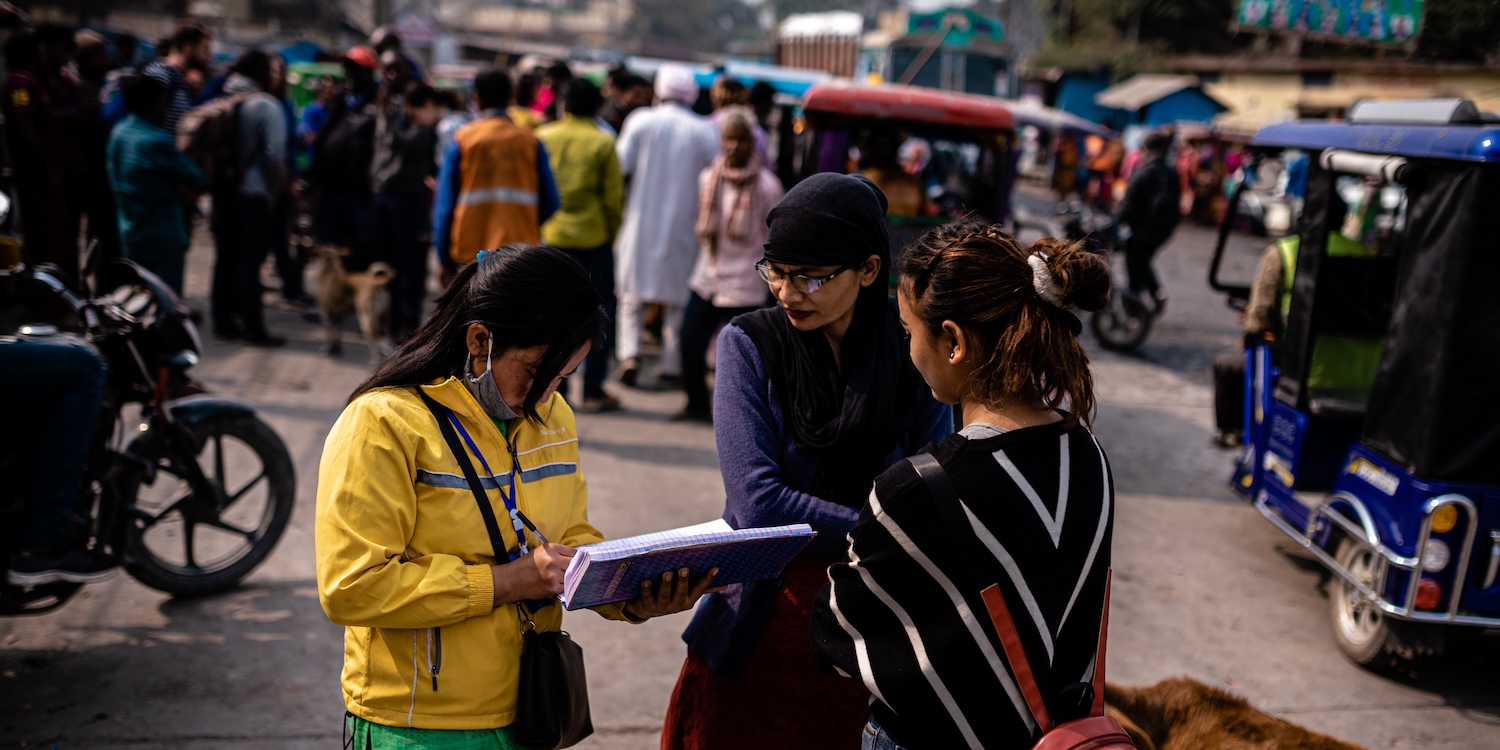
Maya sat alone, tired, head lowered. Nearby stood monitors from the Bangladeshi partner of the organization I lead, Love Justice International — staff trained to identify and intercept travelers who may be in the process of being trafficked. They watched for ten minutes before approaching: fear or traveling alone can signal vulnerability, but neither is proof, and not every vulnerable traveler is a victim.
Maya said she was waiting for her uncle. As the monitors tested her story — Who was the employer? Where would she live? Did her mother know? — it came apart, and the salary proved implausible for the local market. Called to return, the man told Maya to leave and turned threatening. Her mother had been looking for her since morning. The monitors fed Maya and paid her fare so she could go back home; asked later, she said she suspected she would have been trafficked.
This is an example of what we at Love Justice call "an intercept" — a situation where one of our teams prevents a person we have good reason to believe is in the process of being trafficked from continuing (either by convincing them, involving the police, or parents).
We have 62 teams, like the Dhaka team, working in 20 countries around the world, who have intercepted over 115,000 individuals to prevent them from being trafficked. Over the last 12 months it has cost us $161 (fully loaded) to intercept someone, with 2% of intercepts over that time also resulting in an arrest.
At our program headquarters, where I work, a church bell sounds every time an intercept is logged — about once every 5 minutes during working hours.
HOW IT ALL BEGAN
It all started just over two decades ago, when, in my early 20s, I moved to Nepal and founded Love Justice International, largely in response to the words of Jesus, that "whatever you do for the least of these brothers and sisters of mine, you do for me." Two of our core values were "Do Much With Little" (something that will sound familiar to lean thinkers) and "Help Those Who Need It Most." When, sometime in 2005, I learned about human trafficking — how thousands of innocent young girls in Nepal each year were being lured to the red-light districts of India by false jobs and false marriages, broken in by the most heinous abuse imaginable, and forced to service several men every day for someone else's profit — I was heartbroken and began learning all I could about what could be done to fight it.
The problem was that most of the strategies being used to fight trafficking either failed to prevent the exploitation (post-trafficking strategies like rescue and aftercare) or did not have a known tangible impact (prevention strategies like awareness or job creation). I found only one tangible prevention strategy, pioneered along the Nepal-India border by several Nepali organizations. It was called Transit Monitoring — where staff are placed in key transit locations (then mostly border crossings, now also train stations, bus stations, and airports) and are trained to look for signs of trafficking and to use a questioning protocol to uncover and intercept active cases of human trafficking.
At Love Justice, we learned how to do it by asking our Nepali partner staff to do it and observing them. We interviewed them and wrote down what they said, in what would become one of our first Core Processes: the Transit Monitoring Standard (TMS). This guidebook paved the way for us to start new stations, and it was not long before our stations began spreading across the Nepal-India border. We were soon intercepting more than 100 people each month.

THE ELEMENTS OF OUR MANAGEMENT SYSTEM THAT REFLECT LEAN
Each move the Dhaka team made when they intercepted Maya follows the interception steps listed in our TMS.
Step 1 is watching for ten minutes, looking out for a defined list of signs of trafficking, printed on the Intercept Record Form.
Step 2 is questioning following a protocol that always opens with "Where are you going and why?" The monitors asked Maya where she intended to go, why she was sitting alone, and whether she needed help.
Step 3 is scoring. The form lists red flags, each with a weight, grouped in three sections: vulnerability, danger at the destination, and illegitimate means of control. A case has to clear a minimum in each section and a higher total overall before we treat it as evidence of trafficking — a bar we raised recently to push toward higher-quality intercepts. On Maya's form, the monitors marked four: promised pay more than double the normal rate (10 points), under 18 and enticed away without her family's consent (10), fare paid by someone who was not a relative (7), and no address or phone number for the job (5). The monitor then rates, from 1 to 5, how sure they are that the intercept was right; for Maya it was 5. Monitors drill the protocol in pairs, one holding the form and playing the "potential victim."
The 80-page TMS is the station manual, adapted for each country: subcommittee, staffing, awareness, security, accounting, interception, reporting, care and legal cases. In the terminal, the monitor works from the form; the manual is for everyone around the monitor. Each station is overseen by a local committee of 5 to 13 members, drawn from local churches, that meets at least twice a month to ask how the work can be more effective. The TMS calls an active subcommittee "the single most important factor in making an effective transit monitoring station." It is also our oldest guard against false intercepts: members directly experience the fallout of a wrong call. A Bangladesh station's scored monthly report awards points each month for the number of subcommittee meetings held and station visits made.
Writing the standard turned out to be the easy half. When, after months of work, the TMS was first completed, I handed it to our stations and mentally sat down to rest, feeling I had surely secured a future of operational excellence. It was our board chair Mike who first pointed out, "Don't you have to actually make sure they read it, and, you know, are doing all the things?" I realized with an "ugh!" that he was surely right. As the stations multiplied, so did the complexity of tracking the things the Transit Monitoring Standard said they should do. It turns out there are a lot of things; the latest iteration of the TMS is 80 A4-sized small-margin pages, and our station monthly report tracked around 100 things from the TMS that changed every month for around 20 stations. How was a national office coordinator supposed to track that on a whiteboard, let alone prioritize specific action items? In response to this problem, we created our first Operations Dashboards — it started out as Google Sheets that tracked the most important things for all the stations each month and gave the national office coordinators prioritized actions based on weightings. Slowly, this tool started causing all the stations to do the things they need to do in order to do transit monitoring well.
We had our own names for all of this — the Transit Monitoring Standard, the Intercept Record Form, the Operations Dashboards. The lean people who have looked at our system since February tell us some of these have lean counterparts: the steps, the form and the drilling in pairs are what they call standard work. The dashboards they call visual management, though they fit that name less well — they report to a national office once a month rather than showing the work to the people doing it. I come back to the differences at the end.
SCALING BEYOND NEPAL
Getting all that to work took years. Between 2010 and 2014 our loaded anti-trafficking budget grew from $73,500 to $453,500, while intercepts fell from 1,607 to 1,228. We realized that we had already picked all the low-hanging fruit in Nepal — that by the time you have 20 stations, your 21st won't be as effective as your first. If we wanted to scale our impact, we needed to figure out how to make transit monitoring work outside Nepal.
The TMS and the dashboards were only the start. We also needed the Intercept Record Form, which guides the monitor through the questioning protocol and records the red flags, plus Suspect and Location Forms, a Budgeting System, and Searchlight, our trafficking database. But we were in well over our heads. We were just a handful of mostly just-out-of-college expat staff who raised their own support while living in Kathmandu, building out the structures and processes we would need to scale Transit Monitoring. Throughout this time, we read business books and often built a tool from scratch only to learn later that it was a well-established field.
Over those years, we had two failed pilots in Bangladesh, and others in Thailand, Cambodia, and Mongolia. It wasn't until 2015 that a third attempt finally succeeded, at a train station in Dhaka, Bangladesh — the very place where Maya was intercepted. Two factors led to this breakthrough: (1) we realized that Transit Monitoring didn’t always need to happen at a border crossing (Nepal-India is an open border, whereas the border in Bangladesh is heavily guarded by armed border forces on both sides), and (2) we brought in a Bangla-speaking project manager who had experience overseeing transit monitoring in Nepal. Shortly afterward, we opened in South Africa, where our program headquarters now is, and expanded across the African continent.
But we did not really figure out how to scale until we restructured around our headquarters’ core competency — that is, our understanding of what our role should be relative to our national partners: searching out the people, places, and tools to maximize mission impact. We had learned how hard it is to judge character across cultures, and how essential the right people are, so we have come to specialize in finding them — above all the national leaders we work through, our "Champions." We use data science to help choose the right people and places; building a data science team made sense anyway, since we have quietly assembled one of the largest datasets on trafficking cases we know of. The "tools" are our core processes: forms like the Intercept Record Form, documents like the TMS, and software that turns our data into actionable insights.

LOOKING FOR PROBLEMS
We were reporting hundreds of intercepts, and several people were asking, “Are we sure all these are real?” My initial reaction was defensiveness. I didn't want to entertain the possibility that I might be telling people about this amazing impact that wasn't real. But a few voices more fair-minded than me kept pushing — and eventually I would reluctantly agree to begin investigating all suspicious intercepts.
"Admit Your Weaknesses" became a value, and we began the practice of intentionally identifying weaknesses in every division each year (which would soon turn known weak areas into strengths, over and over). And skepticism about our own impact would become baked into the DNA of Love Justice, with intercepts passing through a robust verification process before being counted, semi-frequent back-correction of impact, and eventually regular outside expert review of random samples of our impact.
Every intercept passes through verification before it is counted. In 2019, 2020 and 2021, about 5% of intercepts were overridden or marked as not counting; in each of the last three years it has been under 1%. Those higher years were when we were pushing hardest on training for this process. We also correct published figures after the fact: 12 corrections in 2022, 330 in 2023, 60 in 2024, 42 in 2025, and none so far in 2026.
This year we arranged external reviews of intercepts in five countries. Across 400 cases in Zambia, Sierra Leone, Mozambique and India, independent consultants confirmed 81% as genuinely at risk of trafficking; Nepal’s results are still to come. Their main criticism was that we sometimes count vulnerability — a runaway or lost child, an undocumented trader, someone in poverty — as trafficking risk without enough documented evidence of deception or exploitation. A new Intercept Record Form, an intercept quality measure and better data entry are our response. We intend to run these reviews in every country from now on.
IMPROVING CORE PROCESSES
We have 30 Field Core Processes in our transit monitoring work. These are "installed" (adapted and trained on) in the countries where we work. We have an additional 58 Core Processes that govern how Love Justice functions. Each core process has a lead and a set of stakeholders, whose job is to help that CP become not just “world class”, but "kingdom class" — "more like what God intends for that tool or system than anything that currently exists. "We also measure them, against a fixed rubric. We audit each core process on a one-to-three-year cycle: we began by auditing all of them annually, and still do for some, while for others we moved to every two or three years. We have seen these processes improve over time, and I believe that improvement is part of why our impact has grown — the evidence I have is below.
Here is one core process across six audits. Monitors Training is the three-day course every new team receives at the start of a pilot: the organization and the roles around a station, the TMS, the Intercept Record Form and scenario practice, a day monitoring alongside experienced staff, then security. The rubric scores stakeholder meetings, documentation, training and implementation, expert review, end-user and stakeholder feedback (40% of the weight), and an internal review. Its scores from 2021 to 2026 run 49, 55, 74, 74, 79, 86. In 2022, the end-user survey scored zero because no one had asked the end users. The rubric gives 40% of its weight to collecting feedback, so the first part of the rise happened because we started to ask by building a survey into every training. In 2023, a focus group of field staff called the deck too long ("reduce it to 30–50 slides"), too academic, hard to translate, and short on video and practice. The stakeholders stripped out slides belonging to other core processes and added a case-narrative workshop, monitoring tips, impact expectations, and monitor care. The 2024 score was flat, partly because no focus group was held. By 2026, the first outside expert review — after four years scoring zero on that criterion — was under way, with one recommendation pending: practice in every session, not one. End users still rate it 4 out of 5 and still ask for a simpler structure and more field time, and we are currently building the refresher training they have requested since 2023.
The same record tracks all 30 field core processes. Of the 22 audited at least twice, 17 scored higher at their latest audit than at their first, and the average rose from about 62 to about 74 (the rubric was revised in 2023, so early scores are not strictly comparable). The gains are uneven: the Partner Board Mandate went from 31 to 88, while the Station Feedback Report fell from 80 to 48.
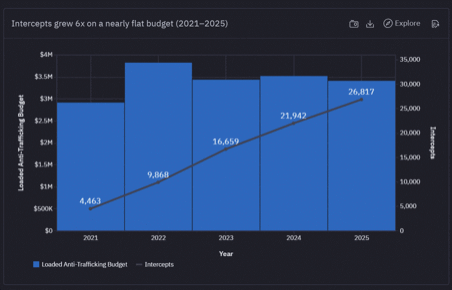
Over the same years, the chart below shows yearly intercepts growing sixfold, from a depressed post-COVID baseline of 4,463 in 2021 to 26,817 in 2025, on a budget that moved much slower. Arrests more than doubled (175 to 382).
Love Justice oversees our partners’ work in three ways, each with corresponding divisions: (1) engineering (the building and improving of core processes; we use a framework called Love Justice Labs to build core processes), (2) installation and compliance (adapting and training on core processes and following up to ensure they're being used correctly), and (3) stewardship (same-culture or near-culture budget oversight and coaching). I am convinced that these things — and some other key values like "Fail Fast and Often," and "Allocate by Impact" — are the reasons we've experienced five years of nearly unbroken monthly improvement in dollars-per-intercept coming out of COVID.
HOW WE FOLLOW UP
“Following up” means a chain of scorecards. At a Bangladesh station, each monitor logs arrival and departure times and the number of people questioned each day. A 31-item monthly checklist covers starting the day with prayer, phoning the project manager the same day about any intercept, sending forms to head office within 48 hours, and receipts for every expense. A scored Transit Station Monthly Report goes to the national office each month. The TMS also defines a station compliance score from seven weighted indicators, from completed Case Information Forms (20%) to verified phone numbers (10%). Stations are told these scores affect their ability to expand. Our intercept verification and quality control process is designed to eliminate low-confidence intercepts.
Nationally, the National Compliance Report scores each country on weighted items grouped under the 30 field core processes — percentages, yes/no answers, or dates. Typical items include share of stations with a functioning subcommittee, IRF data-entry accuracy, and intercept verification lag.
Compliance itself was a late addition. Our installation model was adapt-train-move on, until a colleague pointed out in 2019 that we had no way of knowing which countries were still using a process correctly. The National Compliance Report came out of that conversation.
When a country stops complying, the response is deliberately formal. A “house on fire” becomes official only when headquarters emails the country’s Champion stating what must change, by when, and the consequence. In one African country, in 2024, the project manager had become largely unreachable; the plan was an issues list with measures and dates, a call with the Champion, and a visit; the consequence, a new project manager and then, possibly, withheld funds. The house-on-fire process has led to leadership changes in three country programs.
WHERE WE DIFFER FROM LEAN
Lean readers will also see where we diverge. In Lean, the people doing the work own and revise the standard. At Love Justice, headquarters owns it: core process leads and stakeholder groups revise the TMS and the forms, and stations are scored on following them. Subcommittees improve how the standard is carried out, and monitors shape it through surveys and focus groups, but they do not rewrite it. We hold it centrally because of the division of labor described above, and the “tools” are the written standards, which our small team that started as expats turned out to be good at making and maintaining. Our national partners are better at everything else in their countries. When we restructured around that, we finally figured out how to scale.
DECISIONS DRIVEN BY DATA
“Allocate by Impact” runs through a yearly budget procedure. The primary allocation metric is the Impact Budget Ratio: intercepts plus weighted arrests, divided by budget. Every budget is stripped back each year to a maintenance level, and every expansion item must earn its way back against every other — a practice adopted in 2013 to stop the upward creep of budgets. In 2018, that meant painful cuts alongside elective expansion; over the following year the expansion countries spent 30% of the anti-trafficking program budget and produced more than 70% of the impact.
For my part, I am convinced that charity should be about maximizing impact on the dollar — after all, love does for others what we'd want done to us, and if it were me or my loved ones suffering under injustice, I would want those who help to have the greatest possible impact. That conviction is the pressure that produced everything described above.

WHAT’S NEXT FOR US
In February 2026, George Constance, a retired process improvement specialist, wrote to us out of the blue. He was building a program to bring Lean to non-profits working on child trafficking. Our Chief of Staff, Kirk Schweitzer, who helped build and oversees our Core Process Improvement framework, met with George and spent some time reviewing the systems described above. Since then, Kirk has met with lean experts Andrew Parris, Steve Bell, and Ben Hoseus, who are working to instill Lean in the nonprofit sector.
Every year each of our divisions writes down its biggest weaknesses, and the previous year's list is checked against what has since become a strength. The 2026 list for our anti-trafficking work includes these: our materials and training are too complex; we are a training organization whose training materials are not very good; engagement by boards and subcommittees is very mixed; we are missing opportunities to care for people after the intercept; and the quality of our impact is still not where we want it. Earlier lists carried verification, accounting and corruption, board governance, and subcommittees, which have since become relative strengths. A lean reader would likely add three items we have not written down: we have never mapped the value stream of an interception, we have no disciplined route from a surfaced problem to its root cause, and our annual goals reach the national office but not the station. The bell at headquarters still rings about every 5 minutes during working hours. Each ring is a form that cleared a threshold, a committee that met, a training that stuck. The list above is part of how we intend to make it ring more often.

THE AUTHOR

Read more


FEATURE – In this interesting piece, the author explains how lean provided everyone, everywhere with a framework to work their intuition muscle and develop insights.

NOTES FROM THE GEMBA – The author visits a private engineering school to learn about their approach to teach Lean Thinking and apply it to their own work.

INTERVIEW – We chat with the CEO of a construction company in Dubai to learn about the competitive advantage that lean thinking is providing them.

SERIES – In the final article in their series on lean process development, the authors discuss what it takes to get started with their 6CON process development model.
Read more

CASE STUDY – Following one of the deadliest hurricanes in US history, an NGO started to use lean management principles to speed up the reconstruction of homes in the Louisiana city… and the results were impressive.

INTERVIEW - In this interview, Lynne Smith discusses the potential and difficulties of applying Lean Thinking to NGOs and looks back at the lean transformation at the Gates Foundation.

CASE STUDY – Lean Thinking travels far and wide. Here’s how the experience and insights of an Indiana-based farmer have supported a USAID project to improve outcomes for farmers across Nigeria.

CASE STUDY – Our editor visits TEB, a social enterprise in Barcelona that’s relying on simple kaizen and a growing improvement culture to stay competitive and fulfil its all-important mission.