


Designing human-centered organizations in the age of AI
FEATURE – The Lean Global Connection 2026 will take on the defining challenge of our time: how to build organizations where people and technology bring out the best in each other. Our editor explains why this conversation can't wait.
Words: Roberto Priolo
When the Lean Global Network launched the first Lean Global Connection back in 2021, at the peak of the Covid-19 pandemic, the premise was simple (and a little bold)—bring together the global Lean Community online for 24 hours, across time zones and continents, and prove that genuine learning and connection could happen without anyone boarding a plane. It worked. And we’ve built on it every year since, growing LGC into huge event. The largest online lean event in the world, and an international celebration of Lean Thinking.
As we launch this year’s event, it’s my role and great pleasure to tell you about the theme we’ve chosen for LGC 2026—Designing Human-Centered Organizations in the Age of AI. This is a question that’s keeping lean practitioners, executives, and front-line teams up at night all over the world. And frankly, it’s one we at the Lean Global Network feel a responsibility to address head-on.
THE PRESSURE IS REAL. SO IS THE CONFUSION
Barely a week goes by without a new announcement about AI tools that will transform operations, automate decisions, or replace entire job categories. The pressure on organizations to adopt, adapt, and accelerate is immense. And in the rush, a familiar mistake is starting to appear: treating technology as the answer, rather than as a tool in service of an answer.
We’ve seen this before, time and again. Every wave of technological change has produced its share of organizations that invested heavily in tools and got, at best, marginal and fragile results. The technology did what it was supposed to do, but the system around it wasn't ready. More importantly, people weren't at the center.
Lean practitioners know this pattern well. Which is precisely why the Lean Community has something urgent and valuable to say right now.
Let me be clear about something before we go any further: lean thinkers are not anti-tech, and neither is this conference. AI is an extraordinary development—one that is already changing what’s possible for organizations of all kinds. We find that exciting. The Lean Community has always embraced technology when it creates value, and there’s no reason to think AI should be any different.
What Lean does insist on, however, is a particular approach to technology—one that is deliberate rather than reactive, and that keeps people at the center of the equation. And this is not some kind of a romantic notion. It’s a very practical stance based on evidence accumulated over decades of lean transformations, which consistently shows that organizations that invest in people alongside technology outperform those that treat technology as a substitute for people. The question was never, “AI or humans?” It has always been, “how do we design systems where both can do their best work?”
A CENTURY-OLD QUESTION
Over a century ago, Sakichi Toyoda faced a version of this same question (when the noise around AI gets too loud—and that happens a lot—I like to go back to the basics). When he invented his automatic loom, he effectively built a machine that could detect its own problems and stop—and then ensured that humans were empowered to solve those problems and improve the system. That principle became jidoka (automation with a human touch): machines handle the mechanical work, while people handle the thinking work.
More than a hundred years later, the principle hasn’t aged. The technology around us has changed beyond anything Toyoda could have imagined, but the key question hasn’t: are we designing systems around technology or around people?
WHAT OUR COMMUNITY IS ALREADY TELLING US
At Planet Lean, we've spent the past few months running the Lean Tech Voices column specifically to explore how lean practitioners are navigating the age of AI. The conversations have been revealing.
A recurring theme has been how the organizations seeing real results from new technologies aren’t the ones that deployed the most sophisticated tools. They’re the ones that used technology to surface problems faster, give front-line teams better information, and free up human attention for the work that actually requires human judgment. In other words, they used tech to elevate people, not to sidestep them.
Sandrine Olivencia, lean author and co-founder of Taktique, put it well in the first instalment of the Lean Tech Voices column, which focused on a piece of research revealing that only 7% of all AI investment actually focuses on people. “Can you imagine an orchestra conductor who believes that good music is 93% about the quality of the instruments and only 7% about the musicians? They invest in sophisticated violins and shiny brass, while keeping rehearsal time to a minimum. When the music sounds off and the orchestra loses coherence, they do not question their approach. They simply look for even better instruments. This is exactly how many organizations approach technology today,” she wrote.
That framing has stuck with me. And it's part of what makes this year's LGC theme not just timely, but necessary.
WHAT WE’LL BE EXPLORING TOGETHER ON NOVEMBER 12–13
LGC 2026 will take place on November 12–13, 2026, and over those 24 hours we’ll dig into the practical, the philosophical, and everything in between:
- How to design genuinely human-centered organizations in an era when the temptation to automate decisions is greater than ever.
- How to integrate new technologies into workflows that actually develop people and improve performance—rather than creating workarounds or learned helplessness.
- Why people-first organizations outperform tool-first ones, and what the evidence from lean transformations tells us about why that is.
- How leaders are building resilient, future-ready organizations through Lean Thinking—not despite technology, but with it, on their own terms.
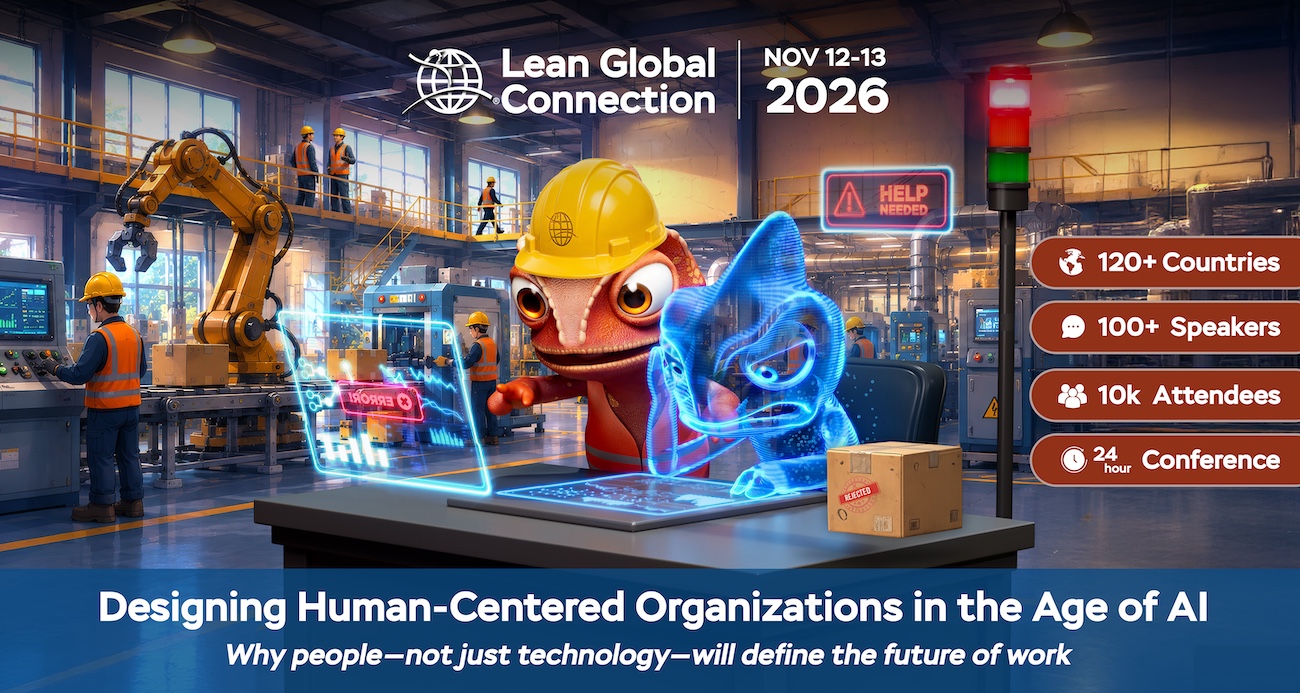
Our mascot Smed the Chameleon—a nod to Lean’s never-ending adaptability—is already at his workstation, and if you look closely at this year’s event banner (and main image of this article), you'll notice something: he’s not being replaced by the AI agent working at this desk. He’s helping it. The machine hit an error, and Smed caught it. That's not an accident. That’s jidoka, 2026 edition.
A CALL TO THE LEAN COMMUNITY
If you’ve ever sat in a leadership meeting where someone proposed solving a people problem with a technology purchase, this conference is for you. If you're a practitioner trying to figure out where AI fits—and where it doesn't—in your improvement system, this conference is for you. If you lead an organization and you're feeling the pressure to move fast on technology adoption while knowing, in your gut, that the system needs to be built around people first, this conference is absolutely for you.
We've spent five years building LGC into a space where the global lean community comes to think out loud together—not just to hear polished presentations, but to wrestle with real problems alongside people who are in the trenches. This November will be no different—and that’s especially important given the topic. We’re not looking for organizations that have cracked the AI puzzle. We’re looking for the ones that are honest about the fact that nobody really has, yet. What we want to hear about are the experiments being run, the hypotheses being tested, the things that worked but also those that didn't (and why). AI is moving faster than any management system can comfortably absorb, and the Lean Community’s greatest strength has always been its willingness to say, “We don't know yet, but here’s what we’re learning.” But in the midst of all this uncertainty, one thing is certain: people need to be at the heart of the organization. That’s the conversation we want to have this November.
The pace of change isn’t slowing down. Neither are we. But we think the most important thing we can do right now—for our organizations, our people, and the future of work—is to resist the temptation to let technology set the agenda. People should do that, and Lean can help.
If you are interested in presenting at this year’s Lean Global Connection, you can email me at editor@planet-lean.com
Read more


INTERVIEW – In this interview, the former CFO of uber-lean company Wiremold explains why our finance people hold the key to our transformation and gives us the lowdown on lean accounting.

BUILDING BRIDGES – Using kaizen, a team at Theodo was able to reduce the time necessary to install a project on a new developer’s computer from three weeks to twelve minutes.

INTERVIEW – Ahead of his presentation at the Lean Global Connection 2026, Tomasz Baum tells about Corning Optical Communications’ program to develop leadership capabilities at the front line.

FEATURE – Day after day, groundbreaking technological advances are dramatically changing industry. It is clear that we are now experiencing a new industrial revolution, but what’s the role of lean thinking in this Digital Age?
Read more

INTERVIEW – AI will shrink companies and workflows, challenging human relevance. In a world of accelerating technological disruption, Lean Thinking and adaptability are more important than ever.

COLUMN – In this column, three lean and technology experts respond to the same pressing question shaping today’s tech/AI debate. This month, why you are not seeing any return on your AI investment.
COLUMN – In this column, three lean and technology experts respond to the same pressing question shaping today’s tech/AI debate. This month, we ask what a lean approach to AI looks like.

FEATURE – During a recent Jishuken workshop, Poland-based Schumacher Packaging experimented with a newly-developed App to quickly create standardized work instructions at the gemba.