

What a flower in Guernica tells us about AI
FEATURE - This year’s Lean Global Connection - and the campaign we have devised to promote it - reminds us that there is a fundamental thing AI cannot replicate: human creativity and resolve.
Words: Roberto Priolo
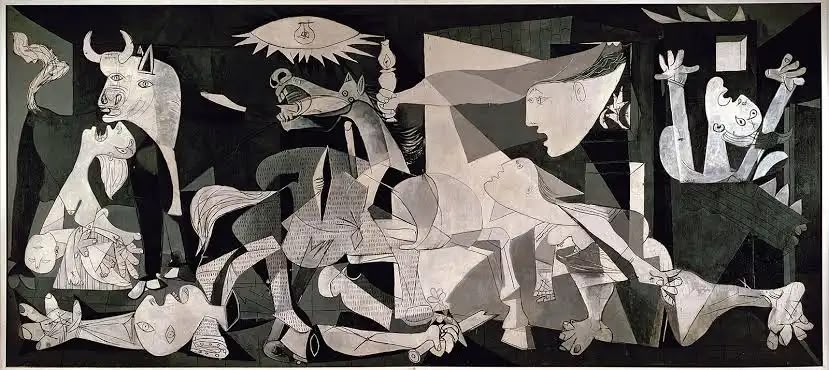
There is a detail in Picasso's Guernica that most people miss when they first look at the giant painting: a small flower growing out of the hand of a fallen man, still gripping a broken sword. Amid the chaos of bulls, screaming people, mad horses, and shattered bodies, Picasso chose to leave that one fragile thing alive. A message of hope in the midst of much suffering and pain. That flower exists because the artist, working through grief and outrage, decided that hope belonged in the image too. It's a strange idea to build into a marketing campaign for a management conference, but it has been coming back to me over and over again since seeing the painting again during a recent weekend trip to Madrid. It so happens that I think it perfectly matches the theme of this year’s Lean Global Connection: designing human-centered organizations in the age of AI.
To promote the event, we could have illustrated the theme with charts, quotes, or the usual stock photography of people shaking hands in front of a skyline. Instead, we decided to make a game of it, featuring our mascot chameleon.
Starting this week, every Tuesday for the next twelve weeks, Smed the Chameleon will be featured in a different work of art, a fresco, a sculpture, a painting spanning centuries and continents. Your job is simple: find him in my LinkedIn posts, guess the artwork and the artist, and drop your answer in the comments. (If you want to help us promote the event, tag a friend who'd enjoy the hunt.) Get eight out of twelve right across the campaign and you're entered into a raffle for a free seat at one of our LGC 2026 workshops.
But the game is really a smaller version of the argument we want to make.
Artificial Intelligence can now generate images, draft text, and mimic style with startling speed. What it cannot do is originate the kind of leap that produced the Sistine Chapel ceiling, or a Bernini marble that seems to breathe, or a Frida Kahlo self-portrait that turns pain into art that transcends time. These works exist because a human being, working within the limits of their body, their materials, and their historical moment, chose to push past what had been done before. That choice, that friction between constraint and intention, is craftsmanship. It's also, not coincidentally, close to what Lean has always been about.
Lean was never a set of tools dropped a factory floor (real Lean isn’t, anyway). It’s a discipline of paying attention, of respecting the people closest to the work, and of trusting that human judgment, refined through practice, produces something a checklist alone cannot. SMED (Single-Minute Exchange of Die) itself, the technique that gives our chameleon his name, exists because someone watched and questioned a process, and redesigned it because they believed there was a better way of doing it.
As AI moves deeper into our organizations, the temptation for many will be to treat human contribution as something residual, whatever the machine hasn't automated yet. This year’s Lean Global Connection (and the campaign promoting it) argues the opposite. Creativity, judgment, and craftsmanship aren't leftovers. They're the point. An algorithm can help us optimize a process, but it cannot decide, the way Picasso did, that a flower (and therefore hope) belonged in a scene of devastation. People at work make such decisions every day, whether it’s a ICU nurse noticing a patient’s breathing pattern before an alarm goes off and alerting the team or an assembler at a torque station noticing the click sounds slightly off and swapping the worn bit before a single fastener fails downstream. It’s this ability to see and solve problems and the dedication to actually do it that will keep organizations successful in the long term - not how many jobs can be slashed as a result of an AI implementation.
So each week, when you're looking at Smed in a famous work of art on my LinkedIn page and trying to figure out which one it is, you're doing something an algorithm can't: you're looking with curiosity, drawing on memory and instinct, and finding delight in the search itself. That, more than any prize, is what we're hoping this contest puts on display — a few weeks before the Lean Global Connection 2026 reminds us why human-centered organizations are still the future.
Register for the LGC 2026 here.
THE AUTHOR

Read more


FEATURE – Lean engineering keeps products alive by relentlessly reconnecting them to real use—learning across generations, shaping clear purpose, and resolving constraints early so value endures as markets evolve.

WOMACK'S YOKOTEN - Given the name of this column, it only makes sense to analyze the word yokoten. So, how can we effectively help others to apply what we learn at the gemba? What makes yokoten successful?

OPINION – Look at today's disruptive companies and you'll see how all of them have understood that real innovation calls for close proximity to the customer, rather than for stubbornly taking cover in the comfort of the upstream.

CASE STUDY - HM Courts & Tribunals Service has been using lean ways of working for over six years, learning many lessons along the way and achieving some fantastic wins.
Read more

FEATURE – The Lean Global Connection 2026 will take on the defining challenge of our time: how to build organizations where people and technology bring out the best in each other. Our editor explains why this conversation can't wait.
COLUMN – In this column, three lean and technology experts respond to the same pressing question shaping today’s tech/AI debate. This month, we dive into why building people-first organizations in more important than ever.

COLUMN – In this column, different lean and technology experts answer the same pressing question shaping today’s tech/AI debate. This month, the question on everyone's mind: will AI really take our jobs?

FEATURE – The author discusses strategy, building resilient systems, and tech CEOs wanting to get rid of middle management.