


Lean in Africa: what we’re learning on the ground
FEATURE – Drawing on Lean Institute Africa’s experience, the author shows why practical Lean, rooted in standards, PDCA, and people development, is necessary in the continent’s complex environment.
Words: Ben Hoseus
I’m originally from the United States. I grew up in Kentucky and started my career at Toyota there. If you had told me I’d end up living in Africa, I probably wouldn’t have believed you, and yet, I’ve been based in Cape Town for the last eight years. The longer I work across the region, the more one message comes through, consistently, from leaders and front-line teams alike: “We like the thinking. Now show us how it works.”
Recently, we at Lean Institute Africa asked our client base and community a blunt question: what are the realities of Lean in the region? The responses were consistent, and pragmatic. They told us that improvement to save time is great, but that they need improvement to save money and fight today’s fires without burning people out. And when organizations invest in improvement, they want proof that it works in their environment (not in someone else’s case study).
I understand where they come from. Lean can easily become a philosophy floating “up in the clouds,” especially when issues on the ground are urgent (as they often are in Africa): cash flow pressure, unstable infrastructure, skills shortages, corruption risks, and a daily fight for survival. In such a context, Lean must be practical. It needs to help people solve the problems they are facing today, in a way they can sustain tomorrow.
At the same time, our community was clear about what they most want systems improvement to deliver at a societal level: job creation, stronger education-to-workforce pathways, meaningful progress on anti-corruption, and the reduction of systemic inefficiencies (from logistics to energy to public services).
And that’s exactly why Lean matters here on the continent, provided we apply it properly.
AFRICA RAISES THE STAKES
Two realities shape everything we do in Africa. The first is demographics: this is a young continent, with the fastest-growing population in the world. That is a massive opportunity, but also a responsibility. The question isn’t whether we have willing people, but whether our systems can turn willingness into capability, productivity, and stable employment.
The second reality is the economic multiplier effect. In many environments we work in, stable employment supports far more than one person. A job often supports families and extended communities. So when a company improves its stability, quality, and competitiveness, the ripple effects go far beyond the factory or office walls.
That’s one reason I love a phrase I first absorbed at Toyota: “Today for tomorrow.” Today’s future state becomes tomorrow’s current state. If we get this right, improvement compounds.
I often come back to Deming’s red bead experiment because it’s so painfully relevant. A willing worker can only succeed within the limits of the system they operate in. You can train and motivate people, but if the process is unstable, unclear, under-resourced, or fear-driven, you will get predictable failure. In Africa, this truth is amplified. I have rarely seen more willingness to work hard, but willingness isn’t enough if the system doesn’t allow people to succeed.
As leaders, our job is to remove the “red beads”—the systemic causes of error and frustration—rather than blaming individuals for outcomes they can’t control.
PRACTICAL LEAN STARTS WITH STANDARDS AND PDCA
As I mentioned above, Lean in Africa has to be practical. If I had to boil practical Lean down to a core, it would be this: we need a clear standard and a simple way to respond when reality deviates from it.
That’s PDCA in its simplest form, based on two fundamental questions:
- What is happening now?
- What should be happening (the standard, target, or expected condition)?
From there, the logic is clean, a gap appears, and we can ask ourselves what we can do to close it.
I’ll be honest: I’ve learned that I spent years doing Lean incorrectly. Like many practitioners, I was biased toward jumping to the future state. What I have realized, in this region especially, is that if we don’t build discipline around standards first, improvement becomes fragile. We end up creating “better” processes that no one can sustain because we never built the foundation: clear work, stable routines, and coaching habits.
If we can’t define what “normal” looks like, we can’t see abnormality. And if we can’t see abnormality, we can’t solve problems consistently.
WHY TWI FITS THIS CONTEXT SO WELL
This realization is why we rely heavily on Training Within Industry (TWI) in our work with organizations. And the more I work in Africa, the more TWI feels like a perfect match.
This approach was born in World War II to rapidly build capability in a workforce that often lacked experience. That mirrors many of the realities here: willing people, uneven training pipelines, and urgent need for operational stability.
TWI gives us practical building blocks (Job Instructions, Job Methods, and Job Relations) to build competence quickly, reduce variation, and create a baseline for improvement, without relying on heroic individuals.
Indeed, provided they are supported by a solid, easy-to-understand management system, teams will begin solving problems before the leader even arrives. That’s when problem solving becomes normal, rather than exceptional, and when Lean starts to have a real impact.
We also have to acknowledge human needs directly. In many workplaces, people carry serious uncertainty: financial pressure, safety concerns, unstable services, and unpredictable futures. If their basic needs are threatened and support is not provided, asking for engagement is unrealistic.
That’s why psychological safety is a prerequisite for surfacing problems. If people don’t feel safe to say something is wrong, the system will just fail. In such a scenario, Lean becomes performative. That’s when people start cleaning up reports and keeping problems hidden.
TO CONCLUDE
Lean will not solve everything. It is not a panacea for every societal issue or structural constraint (let alone for political instability). Our community, in Africa and elsewhere, is right to be skeptical of “one answer.”
But it is a powerful way of thinking. And when that thinking is embedded across thousands of people, practiced daily, and supported by leaders who respect the realities of the context, it becomes a force multiplier. That’s why we as coaches keep doing this work.
Africa is complex and beautiful. The challenges are real, but so is the potential. If we can build practical lean systems rooted in standards, PDCA, people development, and respect, we can create workplaces that are more stable, competitive, and humane. It’s what the African continent needs.

THE AUTHOR

Read more

FEATURE – Last year’s shut-down of Toyota’s Altona plant in Australia moved us all. Here, the former Divisional Manager of Manufacturing offers a first-hand account of how the company made the most of a terrible situation.

VIDEO INTERVIEW - In this conversation with our editor, John Shook discusses Lean Thinking post-pandemic and its role tackling large-scale problems, and introduces an upcoming free event you don't want to miss.
CASE STUDY – A Chilean company selling and servicing vehicles and equipment for a variety of industries has made of humility the leading trait of its cultural transformation, with great results.

FEATURE – In lean, we talk about PDCA all the time… but do we actually practice it as we should? The authors discuss what makes for successful continuous improvement.
Read more

FEATURE – Only when we go where the action is, do we begin to truly understand the work. Rose Heathcote joins the Emergency Medical Services in Cape Town for a day.
FEATURE – At Malamulele Onward in Johannesburg, a do-it-yourself lean transformation is increasing the impact the nonprofit organization is having on South African children living with cerebral palsy.

FEATURE – By looking at the state of lean management in the South African government sector, the author shares a number of important lessons that apply to public service organizations all around the world.
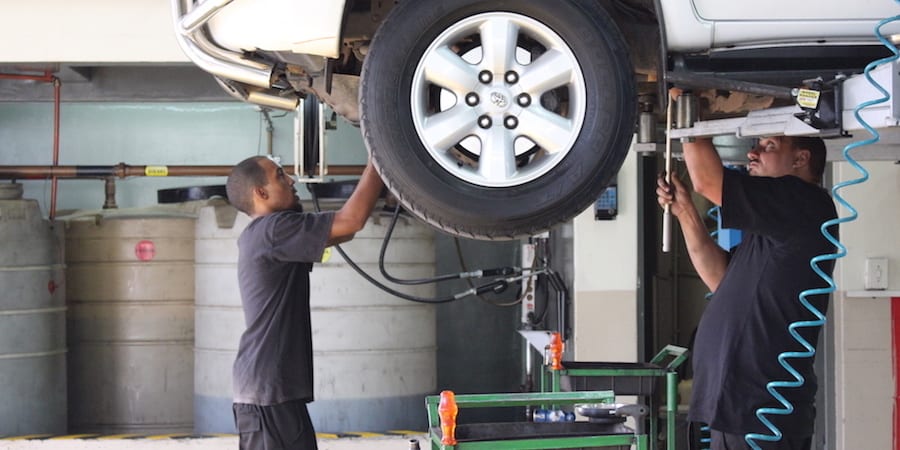
DOCUMENTARY – In PL’s first ever documentary, we share the story of a chain of car dealerships in Africa. Watch and learn how people development and lean leadership made for one of the best turnarounds you’ll ever encounter.