


Just say the word: 5 Whys
FEATURE - In this series based on his latest book What’s Lean?, Michael Ballé explains lean terms, from the most common to the least known, to uncover the meaning and thinking behind them.
Words: Michael Ballé
Roberto Priolo: If the goal of 5 Whys is to decipher a chain of events to find a specific, actionable cause, how do we ensure that we’re not optimizing a single failure point? In other words, what mechanisms do we have to link the local countermeasure to a wider view of the system?
Michael Ballé: On paper, the “5 Whys” looks very simple: you just ask “why?” several times until you find the root cause of a problem. Because of that, it’s often presented as something anyone can use right away. In reality, it’s not that simple. If you don’t already understand how the process works, asking “why?” tends to give very general or shallow answers. You end up with things like “human error” or “lack of training,” which don’t really explain what actually went wrong.
The key idea is that the 5 Whys is not just about finding the previous cause. It’s about finding the condition that made something fail. A system or a component usually works fine under normal conditions. So the real question is: what was different this time that caused it to stop working? Let’s look at Taiichi Ohno’s classic example of the 5 Whys:
Why #1: "Why did the machine stop?"
Answer: There was an overload and the fuse blew.
Why #2: "Why was there an overload?"
Answer: The bearing was not sufficiently lubricated.
Why #3: "Why was it not lubricated sufficiently?"
Answer: The lubrication pump was not pumping sufficiently.
Why #4: "Why was it not pumping sufficiently?"
Answer: The shaft of the pump was worn and rattling.
Why #5: "Why was the shaft worn out?"
Answer: There was no strainer attached and metal scrap got in.
Root cause: No strainer in the lubrication system allowing debris contamination.
Corrective action: Install a strainer in the lubrication system to prevent metal scrap from entering the pump.
As we can see in the way Ohno’s mind works, first he understands the functional mechanism of the machine, and then he can spot what is the abnormal condition that makes the part fail:
- Too much electricity, the fuse blows to protect the mechanism
- Too much friction on the bearin creates electrical overload
- Not enough output from the pump creates friction on the bearing
- Pump shaft worn and rattling will affect pump output
- Metal scrap gets in the shaft causing wear and rattling
So if we look at it in terms of conditions, the questions we will ask are:
- How do we react when fuses blow?
- How do we test our equipment for abnormal use of parts?
- How do we protect moving parts from environment pollution?
These are definitely system-level questions.
Novices tend to make shallow links between symptoms, or think in general terms that don’t necessarily apply. They also don’t recognize abnormalities and don’t see their impact when they do. To correctly pursue 5 whys, you must be expert enough to understand how whatever you’re looking at works and how normal to abnormal conditions affect it, like expecting your car to struggle when you start it on a freezing morning.
When trying to understand a problem, we often look for a direct cause: what broke or what went wrong? And we try to point to a single element (or, often, person). This way of thinking is simple and intuitive, but it keeps the analysis very local. It focuses on one event or one component, without considering the broader situation in which the failure occurred. Instead of asking only what failed, you ask what conditions made that failure happen. This means looking at the environment, the operating state, the level of stress on the system, and how different factors came together at that moment. The failure is no longer seen as an isolated event, but as something that emerged from a specific set of circumstances.
This shift naturally leads to a system view of the problem. You begin to see how multiple elements interact rather than focusing on a single broken part. You notice that the system usually works under normal conditions, and that failure happens only when certain limits are exceeded or certain combinations of factors are present. The problem is not just the component itself, but the situation in which it was operating.
When your car is slow to start on that sub-zero morning, a local explanation might be that the battery is weak. But if you look at conditions, you might see that the weather was very cold, the battery was already partially worn, and the oil had thickened overnight. None of these factors alone might cause a failure, but together they create conditions where the system can no longer perform as expected.
By thinking this way, you move from fixing individual causes to controlling the conditions that lead to failure. This is what gives you a system-level understanding. Instead of reacting to problems after they occur, you can manage the factors that make them possible and prevent them from happening in the first place.
Roberto Priolo: I suspect many people will see themselves reflected in your cartoon. I certainly do. It can be hard to dig deep into a problem without "getting stuck," with no other "whys" left to ask. Any tips to for those who can barely get past the first "why"?
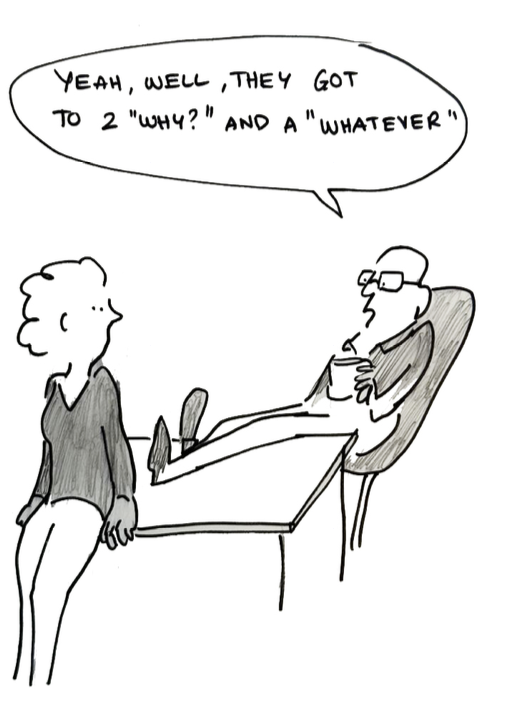
Michael Ballé: Our brains are built for speed, not for deep analysis. Let's imagine early humans in the wild. If the grass suddenly moves, the brain does not calmly analyze all possible explanations. It reacts immediately, as if there might be danger. That quick reaction increases the chance of survival. There is no time to carefully reason whether it is just the wind or a hidden predator (a-ha? Conjecture? Let's test our hypotheses). The priority is to act first and only think later, if there is still time to do so.
Because of this, the brain naturally looks for the fastest explanation that is “good enough.” It prefers simple answers that allow us to quickly move on. In every-day life, this is very useful. We make decisions, solve small problems, and continue with our tasks without getting stuck in long analysis. The brain is constantly optimizing for efficiency, not for perfect understanding.
This tendency also explains why we often stop too early when analyzing problems. When we ask “why” once or twice and get a plausible answer, the brain is satisfied. It feels like the problem is understood, even if the explanation is superficial. Going deeper requires effort, and the brain resists that effort because it is not its default mode.
Forcing yourself to continue asking why several times goes against this natural tendency. It requires discipline to slow down, question your first answers, and keep digging. In a way, you are thinking against your own instincts. Instead of accepting the first reasonable explanation, you deliberately challenge it and look for deeper conditions and mechanisms.
That is why methods like the 5 Whys are not spontaneous. They are learned practices. With training, you develop the habit of pushing past quick answers and exploring the system more thoroughly. But without that training, the brain will almost always choose the shortest path to a satisfactory answer and move on to the next task.
There is also a strong social dimension that makes this even harder. When a problem happens in a group, people naturally want a quick answer so they can move on. The longer the issue stays unresolved, the more uncomfortable everyone feels. There is pressure to restore normality, reduce uncertainty, and get back to work. And if you’re the leader, they’ll turn to you for answers, so that pressure increases significantly. Even if no one says it explicitly, there is an implicit demand: provide a solution, take control, resolve the situation. This attention puts your brain under additional stress.
In that moment, your brain reacts much like it does with any perceived danger. It wants to reduce the tension as quickly as possible. The fastest way to do that is to give a simple explanation and propose an immediate fix. It does not matter if the explanation is shallow, as long as it is convincing enough to calm the situation and allow everyone to move forward. This creates a strong pull toward quick, local answers rather than deeper analysis. You are not only dealing with your brain’s natural tendency to seek fast, “good enough” solutions, but also with the group’s expectation of a rapid resolution. Both forces push in the same direction: close the problem quickly and exit the uncomfortable situation.
Taking the time to go through several whys in this context requires even more discipline. You have to resist both your internal instinct to simplify and the external pressure to deliver fast answers. Instead of immediately resolving the tension, you deliberately hold it a bit longer to understand the real conditions behind the problem. That is difficult, because everything in the situation is pushing you to do the opposite.
To avoid falling into quick, shallow explanations, you need a few practical habits that help you slow down and think more deeply.
First, catch yourself when you say “because.” When you hear yourself giving a reason, especially out loud, take it as a signal. Don’t reject it, but don’t stop there either. Accept that it’s a first answer, then step back and question it. Ask yourself whether it is a real explanation or just a convenient one that allows you to move on. This small pause helps you break the automatic pattern of jumping to conclusions.
Second, return to the gemba and have a second look. Going to the real place and observing the real process makes you look at what actually happened, how the work is done, and under what conditions, until you see and think differently. This keeps the analysis grounded in facts rather than opinions.
Third, draw your model of the situation. Even a simple sketch of how things are connected can make a big difference. Drawing engages a different mode of thinking. You are forced to lay out relationships, flows, and interactions instead of keeping everything vague in your head. This activates more deliberate thinking and makes you more invested in figuring things out properly. It turns a quick reaction into a structured exploration.
Fourth, train yourself to recognize the point of cause and shift toward thinking in terms of conditions. When you identify a cause, ask what conditions made that cause possible or effective. This helps you move from a linear explanation to a broader view of the system. Over time, you start to see patterns of conditions rather than isolated events.
And last but not least, surround yourself with experts you can throw your reasoning at and let them correct your thinking: how do they go about it? What do they look at first? What do they check?
There is no easy shortcut to doing this well. Like any mental discipline, it requires effort and repetition. At first, it feels unnatural because it goes against your instinct to find fast answers. But with deliberate practice, these habits become more natural. By repeatedly catching yourself, externalizing your thinking, reframing causes as conditions, and exploring this domain by chatting to experts, you gradually train your mind to think in a deeper and more systematic way. Never easy, but often profoundly rewarding when you get over the frustrating speedbump of wanting the problem to go away right away.
THE AUTHOR

Read more


FEATURE – This Brazilian manufacturer was able to achieve significant improvements in its processes in just one week thanks to kaizen.

FEATURE - Are Toyota’s MIFA and Value Stream Mapping really different? This article explores their shared origins, challenges misconceptions, and explains why effective mapping starts with problems.

FEATURE – Building on the benefits of the Last Planner System™, lean thinking is supporting people at Turner Construction Company as they solve problems in a structured way.

INTERVIEW – Toyota’s approach to developing capabilities and its focus on life-long learning are inspirational. But how do people at Toyota actually learn?
Read more
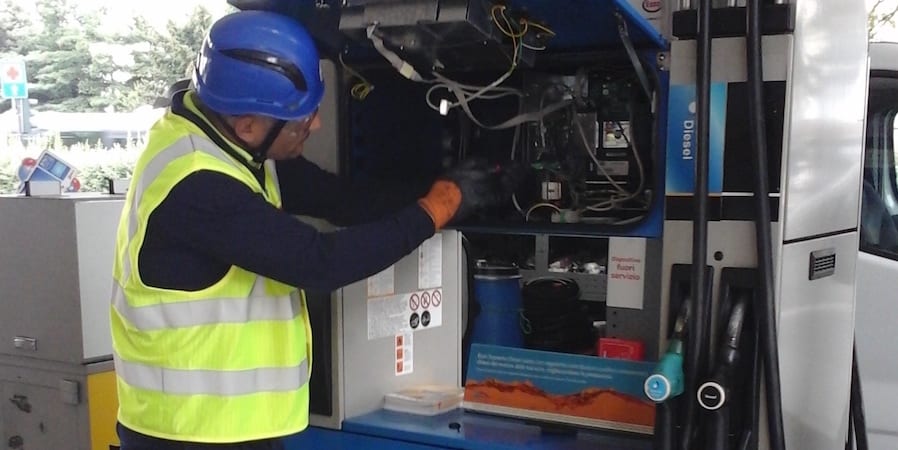
FEATURE – When market changes caused operational problems in their firm, two top managers decided to stick to lean thinking (and a set of specific practices) – learning to focus on what truly matters and letting their people embrace problem-solving.
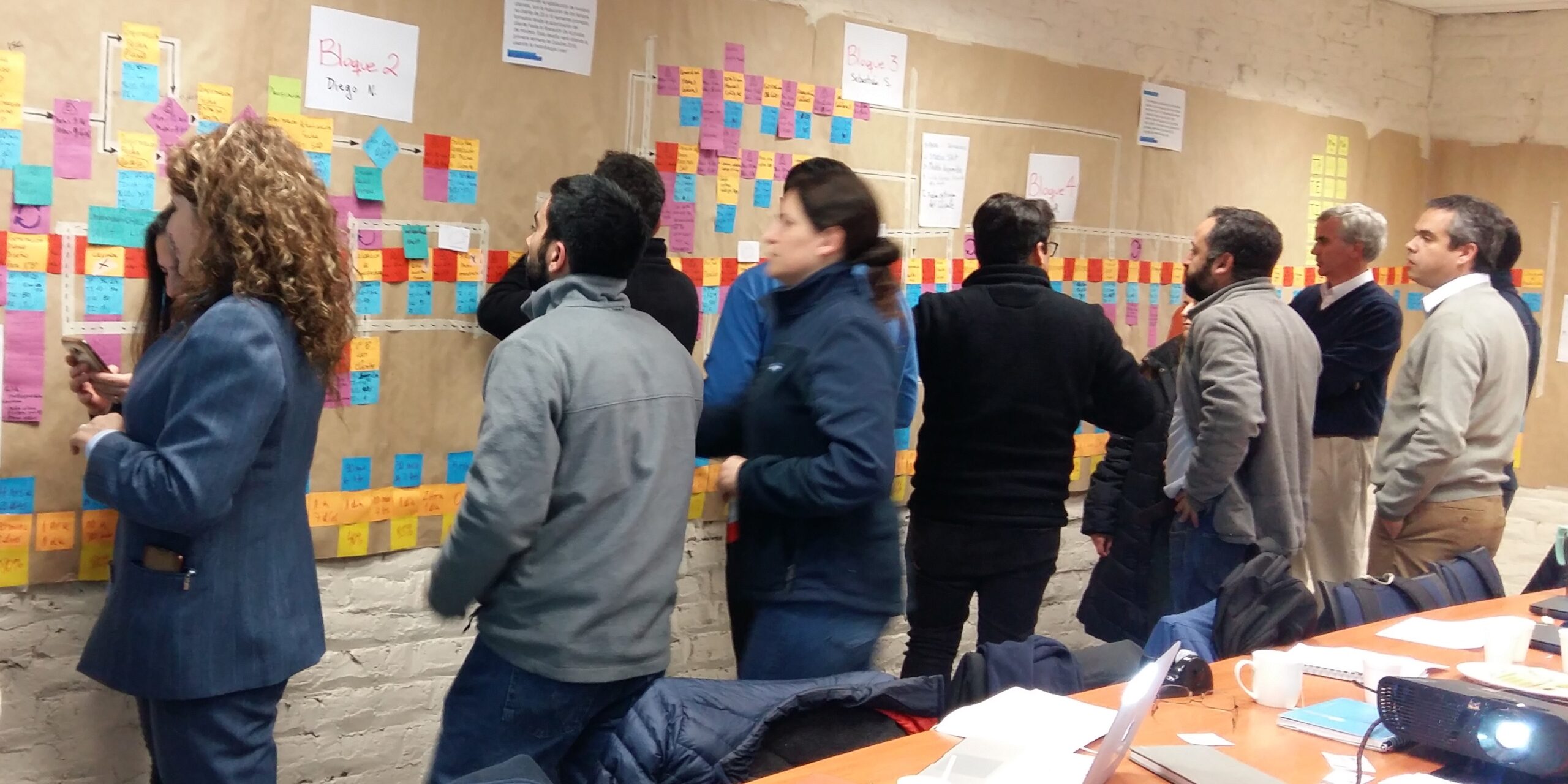
INTERVIEW – Top leaders at Chilean company Elecmetal talk to us about how lean has transformed their role in the organization and how capability development is fuelling change.

FEATURE – Using data from a recent piece of research on logistics, the author discusses how Lean Thinking contributes to a more efficient and effective way of dealing with problems.

INTERVIEW – In this Q&A, we learn how the Technical & Production (T&P) area of Nestlé Colombia Ecuador is using lean and Art Smalley’s four types of problems framework to bring leadership closer to the gemba.