

From planning to performance
NOTES FROM THE GEMBA – In part 2 of this account on her gemba walks at Veolia, the author visits the company’s Majikan hub, learning about centralized planning, standards, and learning systems.
Words: Catherine Chabiron
Last month, I recounted my first gemba walk at Veolia Eau France, in Avignon, at the heart of the company’s operations. Today, I am looking at this organization of 15,000 employees from a different perspective, as I visit their Majikan offices in Roissy, north of Paris.
Frédéric Avila welcomes me to Veolia Eau France’s Majikan offices in Roissy, north of Paris. Now Consumer Director, responsible for all customer relations and services, he until recently led the Majikan operation. Majikan's role is to centrally manage the planning of customer interventions, whether preventive maintenance or emergencies.
TACKLING MISCONCEPTIONS
Frédéric tells me about the value of developing expertise in the planning function. Locally, everyone has their own theory on how to organize customer service calls. Some, for example, suggest filling the technicians’ roadmaps to the maximum, thinking that they will “do what they can,” without really preparing for the call or planning ahead. “They say planning takes too much time, and in any case, there will always be absent customers or emergencies. But in this case, there is a risk of creating real dissatisfaction among technicians in the field and allowing a form of resignation to set in, where the failure of customer visits has become a normal cost of the service,” he explains.
So how can planning that was previously managed locally be effectively taken over by a central entity? What added value can such an entity provide?
Majikan offers both an overview of Veolia Eau France and a fresh perspective on the “centralized” approach. “Our analyses have already challenged a number of preconceptions,” Frédéric tells me. For example, Majikan has shown that the meter replacement rate was difficult to achieve and took a lot of energy, and that each replacement required an average of 1.4 visits (far from being right-first time). “As for the so-called ‘inaccessible meters,’” adds Frédéric, “like those located inside properties and requiring the customer to be present for intervention, the prevailing theory was to go without an appointment, hoping to gain access once on site. We have demonstrated in the Île-de-France region that making an appointment in advance significantly improves the success rate.”
Lean is at the heart of our strategy. We arebuilding a future for and with our customers, adapting to their challenges andconstraints. This means listening to them, trying to meet their needs andknowing how to recognise our mistakes. And we can only do this by developingthe collective and individual expertise of our employees. This requires us tobe on the ground, without losing sight of the horizon - Pierre Ribaute, MD of Veolia Eau France
DOING IT RIGHT: WRITING AND DEVELOPING STANDARDS
Majikan now has 35 schedulers and four managers, who work closely with local group leaders and regional managers. The schedulers first learned their trade from local managers, further developing their skills through real work experience. More precise standards for planning procedures were developed by teams starting in 2023, often with the aim of taking local specificities into account.
Frédéric has a very clear idea of how the standards should evolve: “The idea is to move from ‘We do it’ to ‘Are we doing it well? And why?'. For example, we now have quality standards for what constitutes a successful day for our planners. The next step will be to create a standard that helps the local service succeed.”
In the meantime, we are joined by Victor Mouchel, lean officer at Majikan. He suggests we go and see some examples in the field.
We are in the open-plan office covering the Center-West region, and team leader Farah explains her plan to improve relations with internal customers there. Her idea is to start with Net Promoter Score (NPS) and initiate a dialogue to improve the situation. She shows us a practical example with Nicolas, a local manager, who was able to increase his contact’s satisfaction by engaging in more precise and constructive discussions about the success of technicians in the field, particularly around interventions on inaccessible meters: the score rose from 7 to 9 in a month and a half.
Shortly thereafter, we meet Laura, a young planning manager for the Center-East, East and Normandy regions, who is in the middle of training with Morgane on the "Successful Day" standard. Laura is holding the standard in her hand and is going through it point by point with Morgane in front of the screen. She explains the reason for a step, whenever Morgane asks for a clarification. (Those familiar with Training Within Industry—a training method developed by the United States War Department between 1940 and 1945 to solve the problem of skilled labor shortages at a time when the American war effort required increased production—will recognize in this approach the Job Instructions summary.)
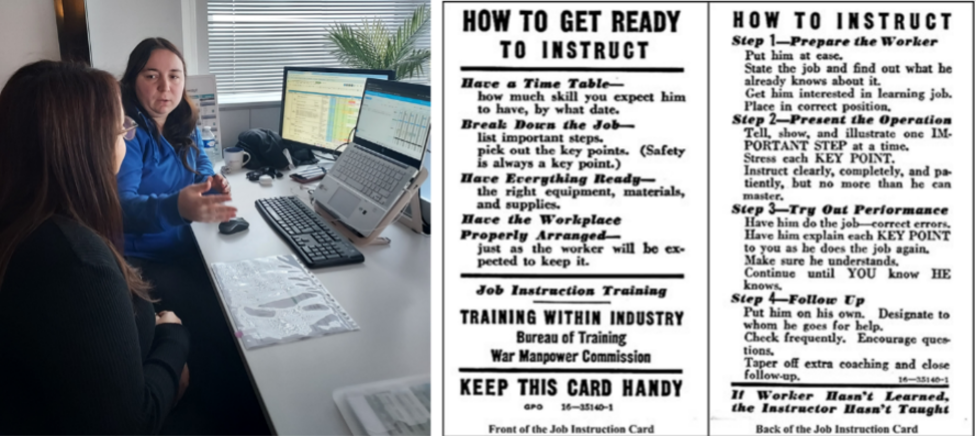
In doing so, Morgane and Laura identify a limitation of the system. Tasks cannot be assigned to employees working halftime for health reasons; the system offers only two options: either someone is absent or they are 100% present. It is important to note that the system's Product Owner, M'Hamed, is on site every Wednesday, sitting alongside employees and going to the gemba. This enables him to identify every request for improvement, a great way to ensure the planning system fits work requirements.
Which flow should we start with? Customer service, whether for repairs or preventive maintenance, seemed obvious to us. We relied on Majikan to analyze, listen to and observe the flow. And thus pull the rest of the organization - Pierre Ribaute
MAJIKAN'S MISSION: TO INTRODUCE THE FIRST GLOBAL CONSIDERATIONS ON FLOW AT VEOLIA EAU FRANCE
Our observations and discussions with Laura and Morgane clearly show the interaction between the local teams and Majikan's planners. The diagram below, created by Laura, explains how Work Orders are created locally, planned by Majikan, and then validated by the group leader or local manager.
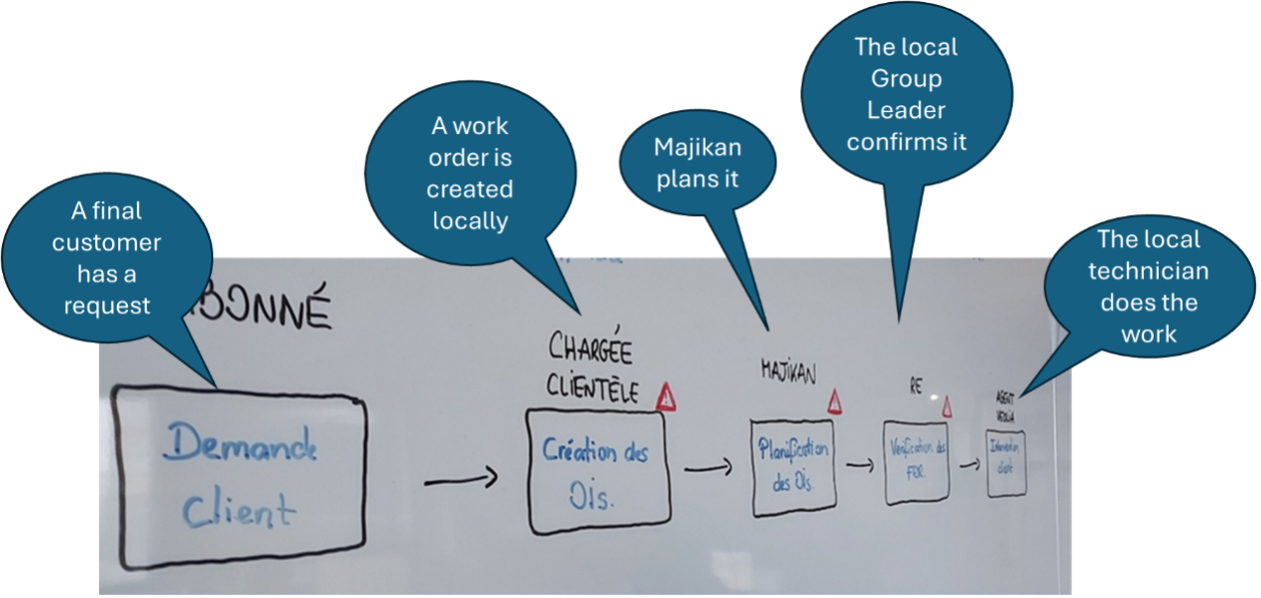
However, depending on the region, not all field interventions are necessarily subject to a Work Order: earthworks (opening trenches), leak detection and preparation for an intervention can represent a significant part of a technician’s activity in certain areas, in which Majikan does not intervene. Majikan only plans contractual preventive maintenance and all “breakdown” processing (emergency repairs) requested by local authorities or consumers (individuals, industries, etc.).
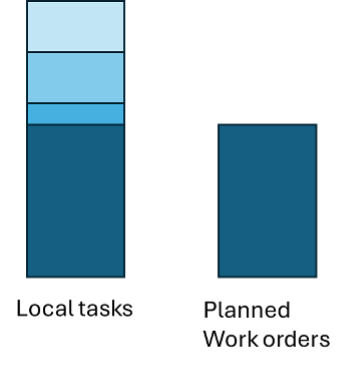
Majikan, therefore, doesn’t always have the authority to organize the entire day for the technicians. Planners regularly report that they do not have enough work orders to keep the teams fully occupied throughout the day: this may lead to technicians appearing to be under-employed with few work orders, while they are in fact having busy days. Some regions also have geographical constraints that planners must consider: for example, there are not as many work orders in areas with scattered communities or in mountainous regions. This requires collaboration with local teams.
Nevertheless, wherever possible, Majikan’s teams began to create a production plan covering all technician tasks, attempting to level each technician’s overall workload throughout the week.
A few steps away from Laura and Morgane, we join Linda, planning manager for Île de France, South and Mediterranean regions. She has made a real leap forward in planning in the Île de France region, gaining the trust of local managers. Her expertise has been called upon to support a new territory, Riviera, in the south of France, whose challenge is to replace 13,800 meters within the year as part of the roll-out of remote meter reading.
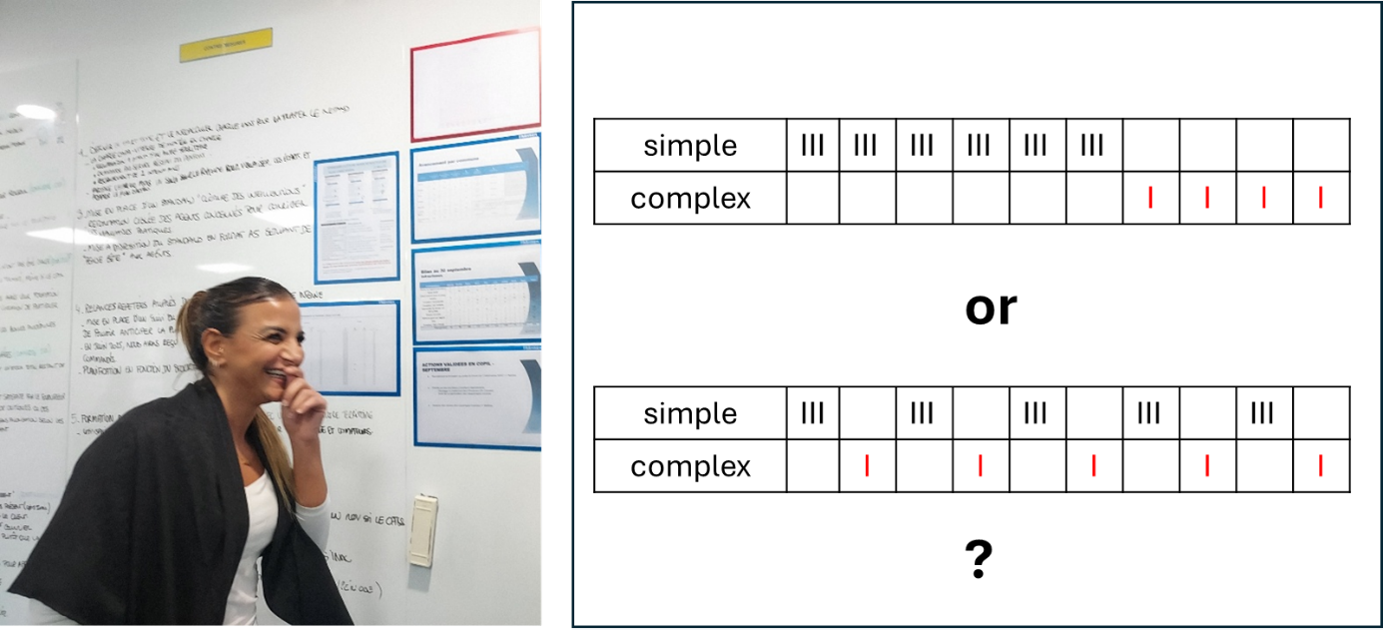
From the outset, Linda introduced the concepts of takt time and levelling the workload. The volume of meters to be replaced is such that it represents a takt time of 8 minutes, which the teams are struggling to stick to: in January and February 2025, the rate they achieved was only one meter change every 18 minutes.
It was necessary to manage issues as varied as the availability of technicians or their recruitment, a lack of knowledge of the intervention tracking system, which led them to close Work Orders when they had made the trip, even if they had not been able to change the meter. But there were also insufficient stocks of meters, absent customers, the pairing of meters installed in areas with poor network coverage, and more. Linda patiently analyzed the five whys and steered the countermeasures with Riviera, regularly giving them an overview and working with them on every detail.
I spot the latest decision on the action plan and we start discussing it: they want to prioritize accessible meters to increase volume, and will postpone tackling inaccessible ones, which Majikan has now demonstrated must be dealt with by making appointments rather than leaving it to chance. This is a well-known levelling issue, and a true Toyota approach would rather alternate between simple and complex meters, thus maintaining an average pace compatible with the customer's takt, rather than save the most complex ones for last (which will require additional trained technicians that Veolia currently doesn't have).
SATISFYING THE END CUSTOMER BY HELPING LOCAL TEAMS SUCCEED
Frédéric and Victor also focused on supporting and training Majikan's team leaders and managers in problem solving. Acquiring such expertise is a way to demonstrate added value for local teams on a daily basis and generates a great advantage.
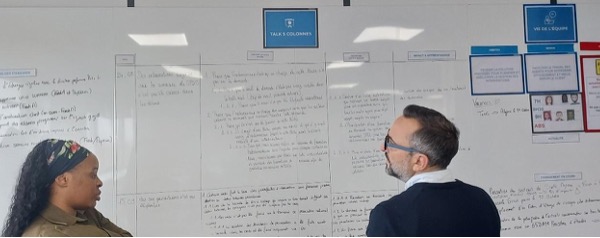
Expertise that starts with oneself. We return to the Center-West region part of the office, where team leader Audrey shares with us a well-documented problem-solving case. Recently, the town of Saint Pierre des Corps sent an email requesting urgent assistance. The email was not seen in time. The action to be taken in this very specific case was known only to a few people, all of whom happened to be on holiday. With ease, Audrey takes us through the 5 Whys, the countermeasures put in place (flagging urgent emails, expanding training to more planners, etc.), and the effect they had. The customer's local contact was duly informed of these actions and the lessons learned.
We then return to see Linda. She is thinking about improving the "Successful Day" standard. What Majikan clearly sees in its planning system, as Linda shows us, is a recurring gap between what is achieved and what is planned. Traffic delays? Last-minute emergencies? Tasks taking longer than expected due to a lack of prior knowledge of the site? Overly ambitious planning? Training issues? Simply reporting the gap is an opportunity to start a new conversation with the local teams, however difficult it may be, and try to help them.
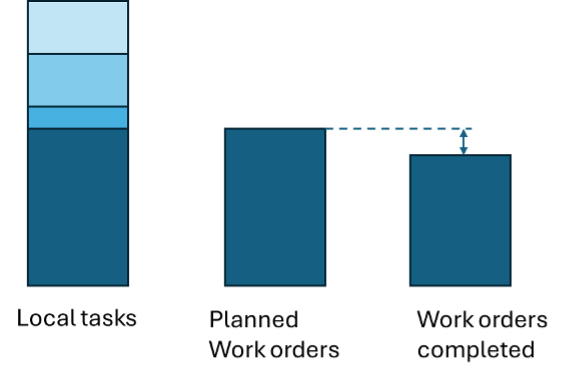
“This is a real opportunity for progress at Veolia today,” says Frédéric. “In debriefings, we focus on what went wrong, where we were able to intervene. But we don't really look at planned interventions that weren't carried out, probably because they are automatically repositioned in the system. This is a great learning opportunity.”
Majikan is thus rediscovering the concept of regular production analysis for the work order flow.

ACCELERATING LEARNING THROUGH COMMUNITIES OF PRACTICE
We end our gemba walk in the area where Victor leads Majikan’s communities of practice, which is also a rather unique initiative at Veolia Eau France at this stage. Learning is always an individual process, involving serious research into causes or the testing of countermeasure effectiveness. Each individual's learning speed depends on where they feel sure of what they know and where they feel doubtful, and a large-scale, forced deployment of knowledge or actions will always come up against this limitation. For an organization that needs to accelerate the work of exploration and reflection carried out by its team leaders, it is now clear that a community of peers, practicing the same profession, is the most effective way to stimulate and encourage buy-in.
Victor leads two communities of practice per month, bringing together all Majikan team leaders and managers: one is focused on internal customer feedback; the other on problem solving, drawing on two or three recent examples of completed improvements.
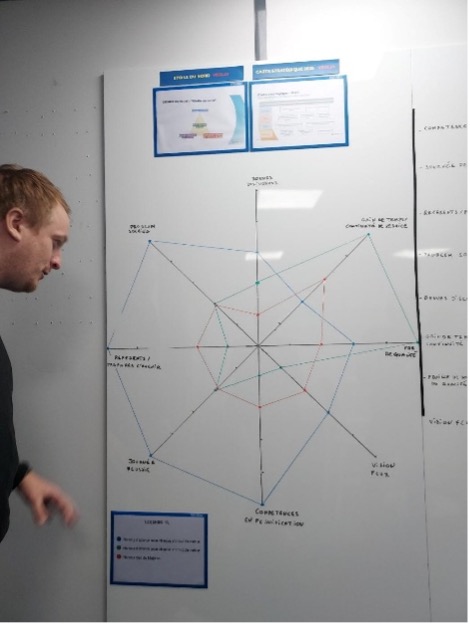
Victor has a clear idea of what he is looking to achieve with these communities. “First, we want to influence the nature of the conversations taking place among schedulers, team leaders and managers—otherwise we’ll likely remain at the anecdotal level,” he tells me.
He also wants to foster sharing and learning: “We facilitated the September community by asking them three questions. What have you learned? What made you change your mind? What does a new hire at Majikan need to know? The answers were very concrete, making us want to dig deeper into the issue right away without waiting for a similar problem to arise.” The ultimate benefit of these communities is that “a community of practice allows you to demonstrate and convince without imposing a method.” A testimonial by a peer will always be more convincing than a directive coming from above.
Debunking misconceptions, challenging the vision of flow, helping others succeed, learning and sharing—this is what we can only encourage any young team to do. I am sure that Frédéric, in his new role as Consumer Director and chief sponsor of customer service improvement, will not fail to do so.
THE AUTHOR

Read more


INTERVIEW – In this interview, Michael Ballé discusses lean thinking as a strategy, how to unearth problems, and the best (or only) way to initiate a lean transformation.

INTERVIEW – The editors of Planet Lean and Lean Post recently met with a senior executive of Turner Construction in New York City. Together, they discussed leadership development, respect for people, and the future of the industry.

CASE STUDY – Lean Thinking travels far and wide. Here’s how the experience and insights of an Indiana-based farmer have supported a USAID project to improve outcomes for farmers across Nigeria.

FEATURE – The author, a lean leader from Germany, recounts his experience bringing lean change about and discusses what it takes to truly learn lean thinking.
Read more

NOTES FROM THE GEMBA – By renewing its focus on value and turning the gemba into a place for learning, Veolia Eau France is improving safety, efficiency, and customer satisfaction. (Part 1 of 2)
NOTES FROM THE GEMBA - We follow the author on a visit to a train maintenance center in France. Through practical examples and pictures from the gemba, she explains how the center is transforming itself.

NOTES FROM THE VIRTUAL GEMBA – Despite a 40% drop in sales and the looming prospect of having to furlough part of its staff, this French company is finding in lean manufacturing an ally to fight the current crisis.

FEATURE - Managers often confuse doing work with managing work. Effective management requires focused metrics—service performance, customer demand, and system constraints—rather than overwhelming, lagging control data.