

Just say the word: Stupidity
FEATURE – The author examines the term “stupidity” as the brain's default mode—motivated reasoning, cognitive dissonance, and groupthink—and how Lean's problem-awareness culture counters willful blindness to inconvenient truths.
Words: Michael Ballé
Roberto Priolo: Lean teaches us to “go and see” the real situation at the gemba, and yet organizations still ignore obvious problems (often resulting from our refusal to acknowledge inconvenient truths) every day. Why is this stupidity such a persistent human tendency, often even in companies practicing Lean?
Michael Ballé: Going is easy, seeing is… complicated. We see what there is. We perceive the world around us with an obvious sense of reality and permanence. But in truth, this is not at all what happens in our brain. Scoop: our eyes only see a small area clearly at any one moment, mostly the center of where we are looking. Everything else is much blurrier and less detailed than it feels (maybe you knew this already). Our brain constantly moves our eyes around, collects little pieces of information, and quickly fills in missing details using memory, patterns, and expectations, which is how the world feels complete and stable even though our visual input is partial and imperfect. What we experience is not a perfect live picture from our eyes, but a fast reconstruction our brain builds from limited data. In effect, we are dreaming awake, but the brain gets more input for prediction and correction. Call it a corrected hallucination.
I mean, this is so huge. We simply cannot get our heads around it and we get on in our lives thinking that what we see is what there is, which is usually good enough. But when it comes to understanding what happens, the construction part of our reality is even greater: what do we recognize as a problem and what do we think is not? Pass the Swiss French border and note that cleanliness is less an issue on the French side that on the Swiss. Surely these people can see that paper in the grass? Or maybe not. Or they don’t care. Or they don’t see the significance. Or, most likely, they don’t know what to do about it, so they just drive on.
If consciousness is a process of simulation and correction, no matter how “real” it feels, it must have key characteristics, surely? Well, it does.
First, it’s almost always intentional. Consciousness is about something: objects, memories, ideas, sensations. Unless you’ve been meditating with yogis for decades in the mountains, it doesn’t exist in a vacuum (and even they have an object: awareness of awareness). Which makes most of our thinking motivated thinking. Our brain unconsciously bends the way we interpret information, so it matches what we want to believe, protects our identity, or avoids emotional discomfort. Instead of looking at facts first and forming conclusions afterwards, the brain naturally starts with a preferred conclusion and then searches for reasons to support it. This makes us prone to looking for evidence that agrees with what we already think, defend choices we've already made, or ignore warning signs about someone we like. It's just our brain trying to reduce stress and get on with life.
Worse, when we don't like what we see, we ignore it. It's called cognitive dissonance, the uncomfortable feeling we get when two things in our mind don’t fit together. For example, we all know “smoking is unhealthy” but still many of us still smoke, so our brains feel tension because the behavior and belief conflict, which leads us to say such stupid things as “it’s not that dangerous” or “everyone dies of something.” In simple terms, the brain dislikes contradictions and tries to make our thoughts and actions feel consistent again, by changing the facts before changing its mind.
Worse, when we're in groups, we stop thinking independently because we want harmony, approval, or unity (or to avoid being the one out). Instead of questioning bad ideas or speaking honestly, we all go along with the group to avoid conflict or being excluded (which, to our brain, feels as bad as physical pain). Smart groups can end making stupid decisions because doubts, risks, and alternative viewpoints get ignored. Any team may support a flawed plan simply because nobody wants to be the first person to disagree.
This all makes "what is" very sticky, some sort of consensus between what people agree to see together. It's not like they're deliberately changing what they see to fit the collective (although they might also do that, private truths are rarely public acknowledgements), but generally, they don't see it and when it's pointed out to them, they reject it. The stupidity part of this process is how hard people are willing to fight to exclude obvious facts pointed out to them (human driven climate change, anyone?) rather than accept them, wonder what to do about it and move on. Being stupid is not being blind or biased; it's being willfully so.
The point is our brains are made to be stupid. This is a normal effect of the normal flow of consciousness. Not being stupid requires an effort, in that it needs deliberate countermeasures. Start with a clear and explicit idea of what you expect to see, while staying open to signs that reality may be different. If you know your assumptions in advance, you’re more likely to notice when something doesn’t fit instead of unconsciously filtering it out. When someone says something surprising, uncomfortable, or unexpected, try to get over your rejection reaction and be curious. Teach yourself to respond with “tell me more” instead of arguing right away. That small pause helps shift the brain from protecting its existing beliefs to actually exploring whether it may be missing something important.
Also, you can actively look for the “black swan," the hidden piece of information that nobody is saying directly, but that would suddenly make everything make sense. Start by being very clear about how you believe things should work, what you expect to happen, and why. Then pay close attention when things don't follow that expected path. Instead of forcing events back into your original explanation, assume there may be one important fact, pressure, fear, incentive, or constraint you are missing. Someone is dying to tell you without saying it out loud. The key is to become curious rather than defensive and look for the missing explanation that accounts for the unexpected outcome. That mindset helps you detect problems, misunderstandings, and hidden dynamics much earlier. When Russian forces amassed behind the Ukrainian border, Russia experts largely predicted Putin would not invade, or, conversely, some predicted that he'd invade and take Kiev in two days. Absolutely no one predicted what actually happen—that he'd invade and botch it. The black swan was the Russian army's poor logistical capabilities, which gave the Ukrainian leadership time to organize its resistance.
Finally, when someone says something unexpected, out of the blue, or way off topic, ask yourself, “In what universe would this statement be 100% true?” Often, we go to experts trying to get their opinion on something and when they do give it, we think, “Nah, that can't be, he or she hasn't understood the question.” Chances are the expert has understood the question and answered it expertly but from a different point of view, a point of view of expertise. In complex systems, problems and symptoms are rarely close together or rarely look the same, and they need a deep causal understanding to be figured out. A bottleneck, as in The Goal, is simple: not enough capacity at a point of the process, so throughput is slow. Bottlenecks are also very rare. A choke point, however, is more frequent but harder to see: when variation in demand accumulated at some point that normally has capacity but due to circumstances is now blocked, like the place where traffic always slows in your drive home. There is no capacity issue, but normal variability hits a special circumstance and the process chokes. Imagine that a sensei shows you a choke point when you think bottleneck! You're going to really have to think it through to see it. Most won't. That's what stupidity looks like.
RP: In which ways does Lean train us and our organizations to learn to see the proverbial “elephant in the room”—no matter how uncomfortable or difficult that might be?
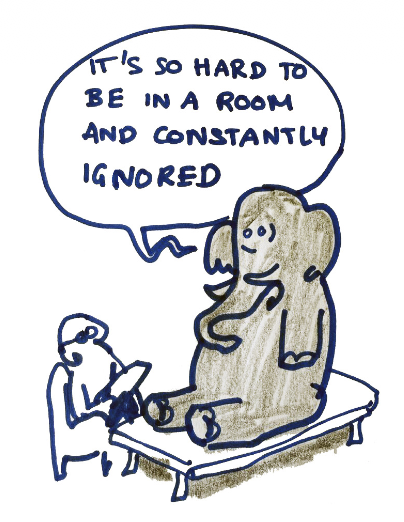
MB: Lean trains us in problem awareness. Problem awareness is the preliminary step to problem solving: it means recognizing a problem when it is not readily apparent and its hasn't been spell out yet. Problem awareness is a mountaineer recognizing avalanche risk by recent snowfall, drifts caused by the wind, rapid warming. Or a seaman recognizing when a first gust of wind comes before a squall, or the choppy seas of wind against current when the tide turns. Sensei will be aware of stagnation in the process, or hidden inventory, quality issues not being resolved that end up passing inspection, people with the wrong attitude, and so on. Lean teaches knowledge in the form of problems rather than solution (recognizing the same problem again and again although it will have different local solutions), so people trained in Lean are more at ease with problems even though they can't see a way to solve them right away. Our motivated thinking is then focused on “finding the real problem” rather than “applying your preferred solution.”
The point of an andon system is not to have a thousand problems but to solve a thousand problems. By “stop and call” hidden problems can be revealed and examined and solved. To make sure workers don't work around missing parts, unclear instructions, or machine defects to keep production moving, you need to come up with countermeasures fast, if not all stops. It teaches you to look beyond the surface and face the fact that the same issues repeat every day and eventually create major failures. Each andon stop triggers an investigation, which means that the plant management learns to have enough expert resources on hand to carry out the investigations, which means it is better prepared to deal with difficult problems. Solving small problems in your daily work is the best training you can have to solve large problems when they appear. You learn to cut the elephant in pieces and solve it piece by piece.
Seeing the elephant in the room, however, is not easier at Toyota than elsewhere. I have had many conversations with veteran sensei frustrated because this or that plant's management absolutely refuses to see a key problem. In the West, in particular, when the sensei points to an issue, the reaction will be to argue against its relevance, importance, or priority. Sadly, the sensei knows this plant is on a Red Queen treadmill... keeping busy going nowhere. To get people to see an elephant they don't want to see, first you've got to send them someone familiar with the elephant and who can explain it, then this lucky chap will have to recruit a few more others willing to open their eyes, and as a network, they have a chance at convincing the rest of the crowd, but it's never easy, or assured.
Respect for people in Lean starts with making the greatest effort to hear each other out and understand each other, so when someone is pointing out something you don't get or are uncomfortable with you teach yourself to answer, “Okay, you're saying X is the issue and I'm ready to talk about it.” This is not so easy because when the issue is embarrassing to someone in power and no one has a ready-made workable solution, everyone’s instinct is just to ignore it and let someone else (who? When?) eventually address it.
A culture grounded in challenge and respect, combined with the habit of daily problem solving, helps lean people recognize the “elephant in the room” because it changes how they relate to problems themselves. Instead of treating problems as signs of failure or embarrassment, people learn that problems are normal, expected, and valuable sources of information. A problem does not need to come packaged with an immediate solution to deserve attention. Simply being able to surface it openly is already progress. Challenge matters because it creates permission to question assumptions, expose contradictions, and confront uncomfortable facts. Respect matters because people are more willing to speak honestly when they believe they will be heard rather than punished or dismissed. Together, these values make it possible for teams to listen to one another seriously and take differing opinions into account instead of filtering everything through hierarchy, ego, or the pressure to appear confident.
Daily problem solving reinforces this mindset through repetition. People become accustomed to examining gaps between expectation and reality without panic. Over time, they develop the discipline to look directly at weak signals, anomalies, and inconvenient evidence instead of reflexively defending existing plans. The organization becomes more capable of seeing reality as it is, not merely as it was intended to be.
But this process has limits. You cannot wake someone who is pretending to sleep. Some individuals become so attached to a solution, a model, or a narrative of success that they stop engaging honestly with contradictory evidence. When identity, status, or prior investment become tied to being “right,” adverse information is treated as noise, sabotage, or temporary deviation rather than as a legitimate warning. No management system or cultural values fully solves the problem. People fixated on a solution will continue to ignore reality until failure becomes undeniable. And even then, they'll explain the plan was still correct “on paper,” and external circumstances, bad luck, or imperfect execution caused the real-world failure.
Elephants in the room are usually either familiar problems everyone outside of the situation would recognize immediately but no one wants to discuss, or a black swan that is whispered about and kinda known that no one has the guts to spell out first. They exist because human beings have limited attention and understanding, and because groups naturally prefer agreement and comfort over conflict and uncertainty. That means elephants in the room will probably never disappear completely. Still, cultures based on challenge, respect, and daily problem solving help people become more willing to notice uncomfortable facts, listen to different perspectives, and speak openly without needing immediate solutions. While some people will always ignore warning signs to protect their preferred narrative, it shouldn't mean we stop trying. The effort to keep looking for elephants in the room and to express concerns clearly and confidently remains essential if groups want to stay connected to reality rather than to their own assumptions, and from then on tackle their real problems and win.
THE AUTHOR

Read more


INTERVIEW – In this Q&A with Catherine Chabiron, Toyota veteran Isao Yoshino discusses NUMMI, management at the company, and how to change the mindsets of leaders.

FEATURE – What a Brazilian bank has learned from its first few steps in adopting hoshin kanri through structured problem solving and people development.

NOTES FROM THE GEMBA – Somfy’s R&D department is applying Lean Thinking to close knowledge gaps, improve collaboration, and boost innovation and technical competence.

CASE STUDY – TechnipFMC has introduced the Concept Paper in its lean product development process. This article shares some of the learnings resulting from the experience.
Read more

SAVE THE DATE – Our editor introduces the theme of this year’s Lean Global Connection, which focuses on rethinking leadership to ensure our organizations can tackle daily issues while keeping an eye on their long-term strategy.

FEATURE – A real understanding of Lean Thinking can only stem from an exploration of its tacit aspects, not just its most explicit, easy-to-grasp elements.

FEATURE – There is more to logistics than an ancillary process that supports the rest of the company. But then, why do we never have a plan for it, like we do for manufacturing?

FEATURE – This article explores the concept of “value network”, emphasizing the importance of looking at lead-times and value creation in a more holistic way.