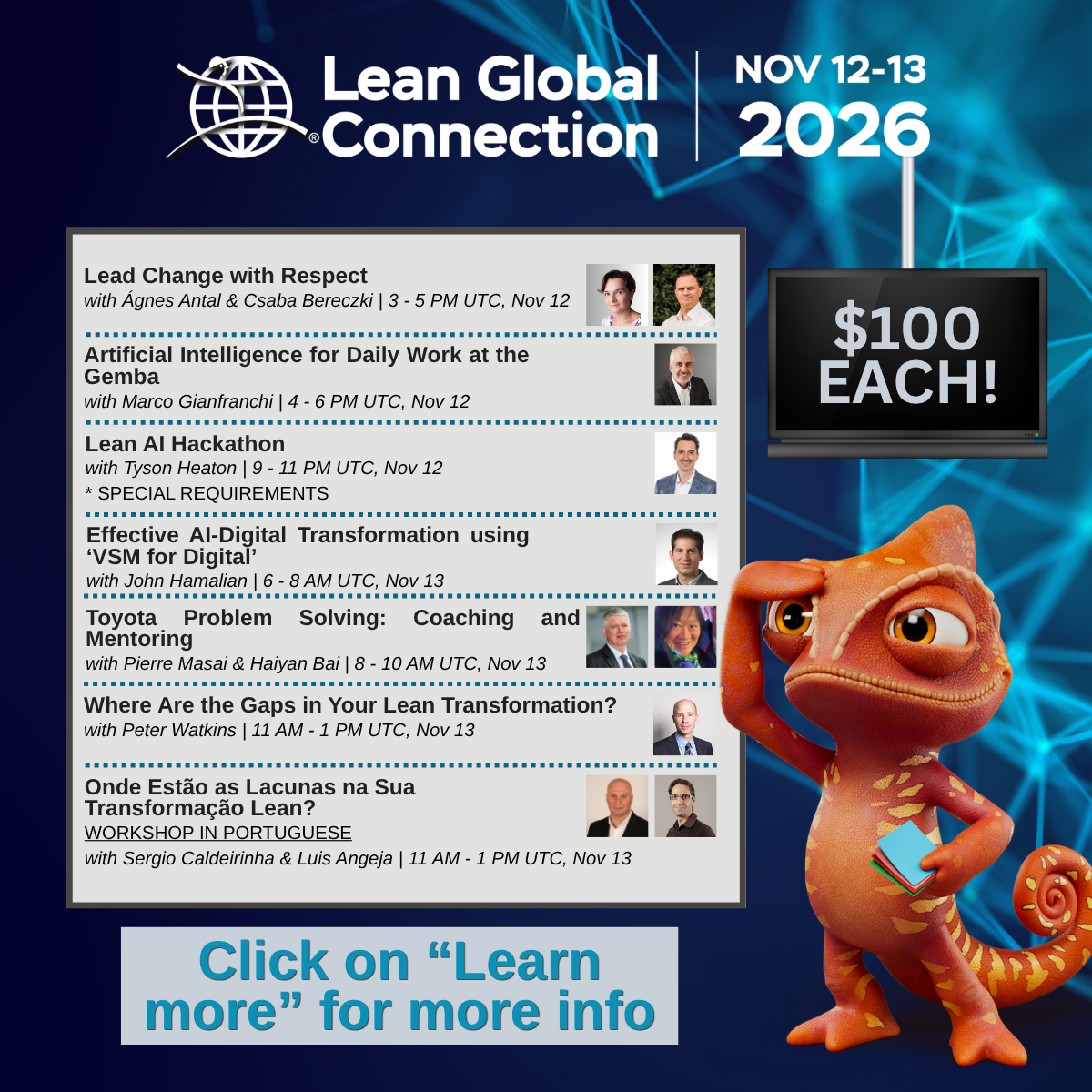
November 12 - 13, 2026
THE WORLD'S LARGEST ONLINE LEAN EVENT STARTS IN:
00:00
120+
countries
100+
speakers
10.000+
attendees
24h
live broadcast
+
countless connections
Register now →

DESIGNING HUMAN-CENTERED ORGANIZATIONS IN THE AGE OF AI

Why people—not just technology—will define the future of work

Organizations today face constant pressure to adopt new technologies, from artificial intelligence to automation and digital platforms. These tools promise productivity gains, cost reductions, and competitive advantage. Yet experience shows that technology alone rarely delivers lasting transformation. The real challenge lies not in the tools themselves, but in how people and organizations learn to use them.

More than a century ago, Sakichi Toyoda confronted a similar challenge when he invented his automatic loom. His solution became the exemplification of the foundational lean principle of jidoka, often described as “automation with a human touch.” Machines could detect problems and stop automatically, but it was people who solved those problems and improved the system. From the very beginning, Lean has treated technology not as a replacement for human intelligence, but as a way to elevate it.

Today, as organizations navigate rapid technological change, the same fundamental question remains: are we designing systems around technology or around people?

At Lean Global Connection 2026, we will explore how Lean Thinking helps organizations build systems where people can thrive, learn, and continuously improve—while making effective use of technology. Whether the context is digital transformation, AI, automation, or operational excellence, the principle remains the same: tools only create value when they are embedded in strong, people-centric systems and meaningful work.

Lean offers a proven approach to designing organizations where:

  • People are developed, not replaced
  • Problems are surfaced and solved at the right level
  • Technology supports learning, collaboration, and performance

At Lean Global Connection 2026, you will:

  • ⁠Explore how to design human-centered organizations in an era of rapid technological change
  • Learn how to integrate new technologies into workflows that develop people and improve performance
  • Discover why organizations that focus on people outperform those that focus only on tools
  • ⁠Connect with leaders building resilient, future-ready organizations through Lean Thinking

As the pace of change accelerates, the real challenge is not adopting the latest technology, but creating systems where people and tech work together to generate value. Lean Thinking reminds us that sustainable success comes not from the tools we deploy, but from the people and systems we build.

‍

Our paid workshops

Sessions

More info coming soon.

No items found.
Text Link
Main Stage
November 12, 2026
14:00
-
14:30
UTC
Opening LGC 2026

Welcome to Lean Global Connection 2026! Your hosts introduce this year's event and its main features

Christopher Thompson
Roberto Priolo
Masia Goodman
Text Link
Main Stage
November 12, 2026
15:00
-
15:30
UTC
Who Killed CESARE? From AI Push to People Pull

CESARE, the company’s internal AI product, didn’t fail because of the technology. It failed because the solution was pushed without first understanding people’s needs. This is the story of what that failure taught FPZ — and how they changed their approach, starting from real needs to develop AI solutions that people actually want to use.

Mauro Mantovanelli
Text Link
Paid workshop
November 12, 2026
15:00
-
17:00
UTC
Lead Change with Respect

Transformations don't fail on the technical side. They fail in the conversations that never happen

Leading change has never been about pushing people through it. It's about going to see, asking why and showing respect — and A3 thinking provides a structure for doing just that. In the age of AI, tools may be changing rapidly, but the hardest part of transformation remains human.

This hands-on workshop explores the human side of lean transformation. Participants will reflect on how they lead people through change, examine their own challenges through the lens of A3 thinking and work with peers in small groups to explore new approaches.

Bring a transformation or change challenge you're currently facing. You'll leave with a fresh perspective and concrete steps to move it forward.

For detailed information about this workshop and requirements, check out the dedicated section at the bottom of the page.

Agnes Antal
Csaba Bereczki
Text Link
Parallel session
November 12, 2026
15:00
-
15:30
UTC
Building a Culture of Quality at Toyota Motor Manufacturing Poland

A quality-conscious workforce is essential to a company's success and to creating processes where quality is built in, rather than relying on inspections to catch defects. People are at the heart of making this happen. This session will explore how Toyota Motor Manufacturing Poland builds quality awareness across its workforce, listens to employees and turns their insights into improvements that help the company meet — and even exceed — customer expectations.

Zdzisław Konior
Text Link
Parallel session
November 12, 2026
15:00
-
15:30
UTC
Where Are the Gaps in Your Lean Transformation?

Why do some lean transformations struggle to make progress or sustain their results? The answer often lies in overlooking critical dimensions of the transformation itself. This session will introduce the five dimensions of the Lean Transformation Framework (LTF), highlighting common failure modes and the challenges organizations face along their transformation journeys. It will show how the framework can help leaders identify gaps, understand where their transformation may be falling short, and make more informed decisions about where to focus their improvement efforts next.

Sergio Caldeirinha
Text Link
Main Stage
November 12, 2026
15:30
-
16:00
UTC
From Kaizen to Code: How Lean Thinking Becomes Everyday Software

What happens when lean practitioners build their own software? With AI as a co-developer, kaizen no longer has to stop at the whiteboard. This session explores everyday tools developed to solve real improvement challenges in industrial companies — from quote generators and production planning systems to KPI dashboards designed to eliminate unnecessary waste. Participants will learn which lean principles guide the design of these tools, what works and what doesn’t, and how to harness AI without automating waste or losing sight of respect for people.

Stéfan Visser
Text Link
Parallel session
November 12, 2026
15:30
-
16:00
UTC
Let Machines Run, Let People Grow

The first phase of Operational Excellence at Coloplast was about making processes stable, efficient, and predictable; the next phase is about enabling people to grow. Join Gyula as he reflects on the lessons learned during the company's OpEx journey and discusses why people development is becoming the most important driver of sustainable excellence.

Gyula Emődi
Text Link
Main Stage
November 12, 2026
16:00
-
16:30
UTC
Can You Afford Not to Invest in Team Leaders?

In manufacturing, success is not determined by machines alone, but by people — and especially by those who lead them. At Corning’s optical fiber cable plant in Stryków, Poland, the team asked a fundamental question: what does an ideal production team leader look like, and how can the company develop one? The answer led to a transformation, turning traditional front-line supervisors into capable, self-aware leaders with a real impact on operational performance. This presentation shares the journey, the decisions made and the lessons learned along the way — including what the program cost, the results it delivered, and why the company now considers it one of its best investments.

Tomasz Baum
Arkadiusz Falah
Text Link
Paid workshop
November 12, 2026
16:00
-
18:00
UTC
Artificial Intelligence for Daily Work at the Gemba

What happens when the PDCA cycle meets the power of Generative AI?

This hands-on workshop explores how AI can support everyday continuous improvement activities, from analyzing scattered information and challenging root-cause analyses to drafting work instructions and preparing for difficult conversations about change.

Drawing on real examples from manufacturing and office environments, the facilitator will demonstrate practical applications of AI across four areas: data analysis, problem-solving, standard work and lean coaching. Participants will have the opportunity to try selected exercises themselves, learn how to critically evaluate AI-generated outputs and understand where these tools add value — and where human judgment remains essential.

You'll leave with practical approaches and exercises you can adapt to your own improvement challenges, helping reduce administrative waste and free up more time for value-creating work.

For detailed information about this workshop and requirements, check out the dedicated section at the bottom of the page.

Marco Gianfranchi
Text Link
Parallel session
November 12, 2026
16:00
-
16:30
UTC
Ask the Coach - Live Q&A

Bring your lean questions to this interactive session with René Aernoudts. With several years of hands-on experience supporting transformations across industries, René will share practical insights and straight answers to real-world challenges — live and unfiltered.

René Aernoudts
Text Link
Main Stage
November 12, 2026
16:30
-
17:00
UTC
Digital Gemba: Walking into the AI-Powered Future of Lean

What happens when lean thinking meets digitalization and AI? In this session, Bosch shares its journey toward the Digital Gemba, where data, AI agents and new problem-solving approaches help employees identify problems, make better decisions, and drive sustainable operational excellence. Through practical examples from manufacturing, the presentation explores how digital technologies can augment Lean Thinking, unlock new improvement opportunities, and equip people with the capabilities they need for the factory of the future.

Marcel Szabo
Istvan Dezsi
Text Link
Parallel session
November 12, 2026
16:30
-
17:00
UTC
Performance = Σ Decisions: How Lean Builds the Clarity to Make Better Decisions

A company’s performance is the cumulative result of thousands of decisions made every day. So how do we progressively improve the quality of those decisions? Lean transformation is not a program to deploy, but a way to build an increasingly accurate map of reality. Through real stories of CEOs learning from the gemba, Julie will explore how Lean progressively creates layers of clarity — about customers, products, flow, problems, the organization and people — so that better decisions can be made everywhere.

Julie Chevalier
Text Link
Main Stage
November 12, 2026
17:00
-
17:30
UTC
The Social Heart of Lean: Improving Processes, Empowering People

Can Lean improve competitiveness while advancing a social mission? At TEB, a Barcelona-based social enterprise employing hundreds of people with intellectual disabilities, it is helping to do both. Through simple kaizen, visual management, structured problem-solving and capability development, the organization is improving its processes while giving people greater confidence and autonomy. This session explores how TEB is building a culture of continuous improvement across a highly diverse organization — and offers a timely reminder, in an age of AI and automation, that improving work means to keep people at the heart of it.

Albert Muñoz
Text Link
Parallel session
November 12, 2026
17:00
-
17:30
UTC
From Design to Construction: Bayer's Lean Approach to Capital Optimization

Bayer Crop Science Engineering is transforming capital project performance by embedding lean principles throughout the project lifecycle. Through examples from sites in Brazil, this session will show how Value Engineering and Set-Based Design have strengthened early-stage engineering, while the Last Planner System, Line of Balance, Daily Management and Standardized Work have improved planning and execution on site. Underpinning these efforts are lean governance and leadership, helping Bayer achieve significant cost savings, shorten project timelines and scale improvements across the region.

Ricardo Otranto
Text Link
Main Stage
November 12, 2026
17:30
-
18:00
UTC
Lean and AI: The Questions We Need to Be Asking

AI is rapidly changing how organizations work, make decisions, and solve problems. But what does that mean for Lean? In this panel discussion, three Lean Tech Voices columnists tackle some of the most pressing questions at the intersection of Lean and AI. From the changing role of people and leaders to problem-solving, continuous improvement and the risks of automating waste, the conversation will explore where AI can strengthen Lean — and where it might challenge some of its fundamental assumptions. Join this open conversation and learn what lean practitioners need to be thinking about as AI reshapes the world of work.

‍

Marie-Pia Ignace
Erasto Meneses
Theodor Panayotov
Text Link
Main Stage
November 12, 2026
18:00
-
18:30
UTC
AI Meets Lean: A Family Affair

What happens when an AI expert and a veteran Lean practitioner sit down to discuss the future of work? Haiyan Bai of the Lean Institute Belgium moderates a conversation between her brother, Haishi Bai, a Principal Architect at Microsoft researching explainable AI, and her husband, Pierre Masai, who spent 20 years at Toyota in Europe and Japan. With perspectives shaped by cutting-edge technology and decades of Lean experience, the discussion promises to challenge assumptions, spark debate and explore where AI and Lean Thinking converge — and where they might disagree. One thing is certain: Haiyan will have her work cut out for her keeping the peace!

Pierre Masai
Haishi Bai
Haiyan Bai
Text Link
Main Stage
November 12, 2026
19:00
-
19:30
UTC
What Can the Toyota Production System Teach Us about AI Coding Agents?

What happens when the principles of the Toyota Production System meet AI coding agents, in a world where software can be generated faster than ever? This session revisits the fundamentals of TPS through the lens of AI-powered software development, exploring how Lean Thinking can help organizations harness the potential of AI without simply automating waste. From improving the way software is developed to ensuring quality and continuous improvement, the presentation examines how AI coding agents can transform software engineering while keeping people at the center of the process.

Remo H. Jansen
Text Link
Parallel session
November 12, 2026
19:30
-
20:00
UTC
Ask the Coach - Live Q&A

Bring your lean questions to this interactive session with Csaba Szalay. With several years of hands-on experience supporting transformations across industries, Csaba will share practical insights and straight answers to real-world challenges — live and unfiltered.

Csaba Szalay
Text Link
Main Stage
November 12, 2026
20:00
-
20:30
UTC
The Dark Cockpit: What Aviation Can Teach Lean Leaders About Technology

What if the secret to better decision-making isn't more data, but less noise? Modern aircraft use sophisticated digital systems to monitor operations and alert pilots only when something requires attention. Known as the “dark cockpit” philosophy, this approach has striking parallels with lean visual management and andon. Captain Gandini will talk about how aviation has embraced automation without removing human judgment from the equation. From managing abnormalities to making decisions under uncertainty, his experience offers valuable lessons for leaders navigating digital transformation and AI: technology should make problems visible, reduce cognitive overload and give people more time to think, solve problems and make better decisions.

Alexandre Gandini
Juan David Ruiz
Text Link
Parallel session
November 12, 2026
20:00
-
20:30
UTC
Before You Automate, Stabilize

In the race to introduce AI into industrial operations, many organizations risk automating chaos rather than solving the problems behind it. This manufacturing transformation case demonstrates why the human foundations of operational excellence — standardized work, daily management and leadership at the gemba — cannot be bypassed by technology. They are what make technology effective when it eventually arrives. The results speak for themselves: double-digit improvements in productivity, operational availability and plan adherence, achieved through people development rather than new technology investments. A powerful reminder that developing people and stabilizing processes are not obstacles to technological transformation, but prerequisites for its success.

Cristian Figueroa
Guillermo Matamala
Text Link
Main Stage
November 12, 2026
20:30
-
21:00
UTC
Lean Thinking for Invisible Work and AI

Even Taiichi Ohno needed hours on the shop floor before he could learn to see waste. But knowledge work has no shop floor to walk, and AI is creating growing inventories that take up no physical space: unreviewed pull requests, unreleased changes, technical debt, unread analyses, yet another architecture... At the same time, AI is quietly taking over the learning that once came from doing the work. Making work visible is no longer enough. Organizations need to deliberately design knowledge work systems around real constraints. Steve will show how to uncover invisible work, connect signals to meaningful responses, and build systems of work and learning that continuously improve without relying on heroic efforts.

Steve Pereira
Text Link
Main Stage
November 12, 2026
21:00
-
21:30
UTC
Leading AI Transformation When Nothing Waits for You to Be Ready

Transformation rarely happens in a straight line — and organizations cannot always wait until they are ready to begin. In this session, ME Elecmetal shares its experience of managing three interconnected challenges at once: adopting AI, strengthening process governance, and developing people with a lean mindset. The presentation offers an inside look at the tensions, lessons, and trade-offs that emerge when all three must move forward simultaneously — and explores what it really takes to lead transformation while the organization itself is still learning.

José Pablo Domínguez
Thenison Atenas
Text Link
Paid workshop
November 12, 2026
21:00
-
23:00
UTC
Lean AI Hackathon

This is a hands-on, coached working session, not a lecture. Participants will bring a challenge they're facing with AI and spend most of the two hours working on it with a frontier AI model, in small breakout groups of two or three, with guidance from the facilitator along the way.

Participants will leave with progress on their own challenges, a better understanding of how AI can support problem-solving and everyday work, and practical experience overcoming obstacles. The session will also explore how to bring this hackathon-style format back to their own organizations to help teams learn and experiment with AI.

For detailed information about this workshop and requirements, check out the dedicated section at the bottom of the page.

Tyson Heaton
Text Link
Parallel session
November 12, 2026
21:00
-
21:30
UTC
Balancing Run and Change: How Lean and AI Shape Customer Experience

How can organizations maintain operational excellence while transforming to meet tomorrow's challenges? Rafael will explain how MAG balances two priorities: Run, where Daily Management brings multidisciplinary teams together to monitor performance, identify problems and drive continuous improvement; and Change, where the MAG Transformation Plan guides the organization's evolution in response to regulatory shifts, business priorities and changing customer needs. This session will show how connecting people, Lean Thinking, technology and innovation can help organizations improve today's operations while preparing for the future.

Rafael Rosas
Text Link
Parallel session
November 12, 2026
21:30
-
22:00
UTC
From Heroics to a System: Lean Transformation in High-Mix, Made-to-Order Manufacturing

Viwinco looked lean. It wasn’t. Behind a one-week, made-to-order promise were overtime, large batches, and firefighting. Told through the five questions of the Lean Transformation Framework, this session shares how Viwinco moved a 100% custom line to one-piece flow, built a team-leader role that didn’t exist, and replaced a 15-page strategy document with hoshin kanri and the Viwinco Performance System, guided by one mindset: fix the process, not the people.

Zach Kauffman
Text Link
Parallel session
November 12, 2026
22:00
-
22:30
UTC
AI and Lean: Are We Building Better Problem-Solvers or Weaker Thinkers?

As AI enters the workplace, lean leaders face a fundamental question: is it strengthening problem-solving capabilities or eroding the critical thinking that continuous improvement depends on? Using a “Help vs. Hinder” framework, Matt will present two practical applications: AI-powered video time studies that reduce 40 hours of manual data entry to just 30 minutes, freeing engineers to focus on improvement; and AI-assisted lean training that makes concepts traditionally associated with automotive manufacturing more accessible to teams in healthcare, food service and office environments. But there are risks, too. From overreliance on AI to declining critical thinking and misplaced trust in its outputs, the challenge is ensuring that technology develops people's capabilities rather than gradually replacing them.

Matthew Savas
Text Link
Main Stage
November 12, 2026
22:30
-
23:00
UTC
Leading Through Uncertainty: The Power of People

Danny will share a compelling story of human-centred leadership in times of uncertainty. Drawing on his own experience, he will explore how creating clarity, stability and a shared sense of purpose enables people to navigate challenges and perform at their best. He will remind us that great leadership isn't about having all the answers, but about creating the conditions where people feel safe, valued and empowered to contribute and improve. Danny's story demonstrates how investing in people, building capability and caring for your team can transform both the workplace and business performance.

Danny Elassaad
Text Link
Main Stage
November 13, 2026
00:30
-
01:00
UTC
Thinking Lean, Harnessing AI: Lessons from a Medium-Sized Company

Many medium-sized companies don't have dedicated continuous improvement teams. But what if that limitation could become an opportunity? Gustavo will share how he developed simple AI-powered tools to help teams apply A3 and value stream mapping, with Lean Thinking at the core. His experience highlights both the successes and challenges of this approach, as well as the opportunities AI offers small and medium-sized businesses to embrace continuous improvement.

Gustavo Gomez
Text Link
Main Stage
November 13, 2026
01:00
-
01:30
UTC
Deployed or Developed: Who Owns Your AI Capability?

Companies are renting AI talent at record pace, with vendors dropping forward deployed engineers in to make AI work. When there's confusion and anxiety about making the wrong call, the default is to outsource to someone who offers a guarantee. But the capability that compounds is the ability to see and improve your own work, and you can't rent that. Drawing on his Lean Post series, Tyson shows what Taylor, TWI and Toyota teach us about outsourced improvement, and how to grow AI capability in the people who already run the work. Not forward deployed. Forward developed.

Tyson Heaton
Text Link
Main Stage
November 13, 2026
01:30
-
02:00
UTC
Don’t Just Swap the Engine: Redesigning Organizations Around People in the Age of AI

Every general-purpose technology starts by replacing the engine. Only later does it transform the factory. AI is now at that crossroads. Drawing on months of fieldwork in industrial design, where engineers once spent days clicking through software, this session explores what happens when people express their intent and AI takes on the work of exploring, testing and verifying solutions. The presentation examines where AI can fail despite appearing confident, why accountability must remain human, and how experts can become “forward-deployed” leaders of their own work. Participants will leave with practical principles for designing organizations where AI amplifies people's capabilities rather than diminishing their role.

Shaoyu Wang
Text Link
Parallel session
November 13, 2026
01:30
-
02:00
UTC
Changing Mindsets, Improving Performance

What if improving operational performance required changing the way people think, rather than investing in new technology? At Vale Indonesia's nickel processing operations, frequent furnace tapping was driving up costs and disrupting process stability. Using the Lean Transformation Framework, the team challenged the practice of initiating tapping based on converter demand, regardless of furnace readiness. Through experimentation, standardized operating conditions and collaboration between operations and process technology teams, the average number of ladles per tapping increased from 3.5 to 6.1. Beyond the operational gains, this story demonstrates how Lean Thinking can challenge entrenched assumptions, strengthen problem-solving capabilities and transform the way people work.

Zul Fajri
Alfi Ria Rusdianto
Elsa Yolanda
Text Link
Main Stage
November 13, 2026
02:00
-
02:30
UTC
Technology Detects, People Solve

Industrial organizations have access to more operational data than ever before. But data alone doesn't solve problems. Real improvement depends on people's ability to identify abnormalities, understand their causes and take action. At ANTAM's nickel processing operations in Indonesia, A3 Thinking and structured problem-solving helped tackle recurring furnace instability and production losses. Through gemba observation, analysis of process parameters and cross-functional collaboration, the team uncovered problems with material distribution, coal feeding accuracy and reductant losses. The case demonstrates how Lean Thinking turns operational data into actionable insights, preventive controls and better daily decision-making.

Ananda Aikaal Aulia Putra
Dhonny Suwazan
Text Link
Parallel session
November 13, 2026
02:30
-
03:00
UTC
The Path to True Excellence: How to Become Really, REALLY Good

Some automotive manufacturers consistently outperform their competitors. Toyota, including Lexus and Daihatsu, stands out, alongside companies such as Nissan and BMW. But what sets these manufacturers apart? Over several years,  Christoph visited and analyzed 17 automotive plants across Japan and 15 in Germany, covering all major manufacturers in both countries. Based on this extensive comparative study, the presentation examines the differences in performance between manufacturers and the practices that help the best achieve operational excellence.

Christoph Roser
Text Link
Main Stage
November 13, 2026
03:00
-
03:30
UTC
Making People Before Making Products

As organizations invest heavily in AI to improve productivity, a fundamental question emerges: how can they preserve human knowledge and develop the next generation of problem-solvers? Fran draws from his experience at Toyota to introduce Shokuba Senpai, a people development approach rooted in the Toyota Way. Through stories from the gemba, he illustrates how experienced mentors transfer tacit knowledge, challenge assumptions and develop critical thinking through daily coaching rather than simply providing answers. In an age of accelerating technological change, Toyota's philosophy offers a timely reminder: sustainable improvement begins with developing people.

Fran Noto
Text Link
Parallel session
November 13, 2026
03:00
-
03:30
UTC
Ask the Coach - Live Q&A

Bring your lean questions to this interactive session with Denise Bennett and Nicole Amsing. With several years of hands-on experience supporting transformations across industries, Denise and Nicole will share practical insights and straight answers to real-world challenges — live and unfiltered.

Denise Bennett
Nicole Amsing
Text Link
Main Stage
November 13, 2026
04:00
-
04:30
UTC
Redesigning Value Streams for Key Customers in the Agentic Era

In the age of AI agents, managing key customer relationships requires looking beyond sales funnels, departmental handoffs and product usage metrics. This session explores how organizations can redesign end-to-end value streams around customers’ real business challenges — from identifying early signals and developing shared hypotheses about value to coordinating actions, learning from evidence and building long-term trust. While AI agents can reduce information friction and accelerate learning, people must remain responsible for setting goals, making decisions, nurturing customer relationships and driving continuous improvement. The aim is not to automate key account management, but to build a more human-centered organization capable of continuously delivering value to customers.

Chengrui Tao
Text Link
Main Stage
November 13, 2026
04:30
-
05:00
UTC
The Rise of Humans: Keeping People at the Heart of AI

We are at a pivotal moment for humanity. In a world where jobs are threatened by AI, the value of human contributions is being questioned, and machines are learning faster than people, this session explores how organizations can embrace high-tech solutions without losing their humanity — and even enhance it — powered by Lean Thinking.

John Hamalian
Text Link
Main Stage
November 13, 2026
05:00
-
05:30
UTC
The Human-Centered Hospital

How can hospitals harness Lean, digital technologies and AI while keeping people at the center? Drawing on the experience of Hisar Hospital, this session explores how physical design and master planning, Lean practices, Asakai-based daily management and AI applications come together in a human-centered management system. Participants will see how these elements support better flow, visual management, problem-solving, learning and continuous improvement — ultimately creating better experiences for both patients and employees.

Samet Doğutaş
Taha Enes Aslantürk
Text Link
Main Stage
November 13, 2026
05:30
-
06:00
UTC
People First, Technology Second: A Lean Path to AI in Manufacturing

The most successful AI transformations in manufacturing don't begin with algorithms or technology — they begin with people. Drawing on real-world examples from a wide range of industries, this session presents a proven three-stage pathway for AI adoption: building solid data foundations, establishing a metrics framework and developing the right organizational culture. Participants will discover how frontline workers can become the driving force behind AI implementation, how the SQCDPE metrics system can turn data into actionable insights, and why Lean Thinking may be the missing link between AI investment and real business value.

Shawn Zhao
Text Link
Main Stage
November 13, 2026
06:00
-
06:30
UTC
Eliminating Chronic Process Errors with A3 and AI

How can lean problem-solving and AI work together to tackle problems that have persisted for years? Faced with chronic issues in its invoice approval process, including system errors and unnecessary payment blocks, a cross-functional team at Brisa Bridgestone set out to identify and address the root causes. Using A3 problem solving, the team mapped the end-to-end process, uncovered systemic weaknesses and leveraged AI to accelerate analysis, review workflow code and develop solutions. This session explores how combining structured Lean with AI-powered insights helped the company reduce erroneous invoice blocking by 89%, demonstrating the potential of this approach to solve long-standing operational problems and deliver measurable results.

Zehra Tanhan
Text Link
Paid workshop
November 13, 2026
06:00
-
08:00
UTC
Effective AI-Digital Transformation using ‘VSM for Digital’ (VSM4D)

Why do so many digital transformations fail to deliver the expected results? Too often, organizations focus on technology while overlooking the people, processes and customer needs that determine whether it creates real value.

This workshop introduces VSM4D (Value Stream Mapping for Digital), an adaptation of the traditional lean tool designed to help organizations rethink workflows and approach digital transformation more effectively. Participants will explore how VSM4D fits into a broader lean approach that combines Design Thinking, Agile and change management to address common transformation challenges.

Through practical examples, participants will learn the basic principles of VSM4D and how to apply them to redesign work processes, avoid common pitfalls and make digital transformation more effective and people-centered.

For detailed information about this workshop and requirements, check out the dedicated section at the bottom of the page.

John Hamalian
Text Link
Parallel session
November 13, 2026
06:30
-
07:00
UTC
Humans Build the Future

AI is changing how work gets done, but technology alone will not define the future of work. The real challenge for leaders is designing organizations where people and AI strengthen each other. In this session, ASML will share lessons from Lean Thinking, organizational transformation, and the AI revolution. Arnoud will explore why judgment, collaboration, problem solving, and leadership become even more important as AI accelerates information, analysis, and execution. Join this session to learn how we can build organizations where technology accelerates performance, while people continue to improve the system.

Arnoud Hoogeveen
Text Link
Main Stage
November 13, 2026
07:00
-
07:30
UTC
When Everyone Converges on the Same AI Capabilities, Who Wins?

Tech CEOs everywhere have embarked on some form of AI transformation, with a mix of AI experts building agents on one side and local initiatives on the other. Taken individually, these are compelling transformation stories, but taken together, they reveal that everyone is converging on the same underlying AI capabilities, with a clear risk of eroding any competitive advantage. So where will the edge come from now? How quickly a company develops its people. AI is a massive reskilling challenge, far more than a technical one. Which raises the real questions: what vision should companies bring to life? What future are they creating for their teams? Fortunately, there's TPS. Value, performance, just-in-time, jidoka, conditions, standards, kaizen: element by element, this talk shows how TPS provides a powerful lens for redesigning companies for the AI era, with people development deliberately at the center of the strategy.

Regis Medina
Text Link
Parallel session
November 13, 2026
07:00
-
07:30
UTC
The Future of Enterprise Performance in Africa: The CEO Agenda for 2030

What will distinguish Africa's highest-performing organizations by 2030, and are today's operating models equipped to deliver? Drawing on emerging insights from Lean Institute Africa's industry research, The Future of Enterprise Performance in Africa, this session will explore the leadership priorities, organizational capabilities and operating model shifts shaping the next era of enterprise performance. Sam will share early findings from across African organizations and introduce a framework for understanding how strategy execution, leadership, operational excellence, digital transformation, and organizational capabilities must work together to create sustainable competitive advantage.

Samantha Allen
Text Link
Parallel session
November 13, 2026
07:00
-
07:30
UTC
The Future of Enterprise Performance in Africa: The CEO Agenda for 2030

What will distinguish Africa's highest-performing organizations by 2030, and are today's operating models equipped to deliver? Drawing on emerging insights from Lean Institute Africa's industry research, The Future of Enterprise Performance in Africa, Sam will explore the leadership priorities, organizational capabilities and operating model shifts shaping the next era of enterprise performance. She will share early findings from across African organizations and introduce a framework for understanding how strategy execution, leadership, operational excellence, digital transformation and organizational capabilities must work together to create sustainable competitive advantage.

Samantha Allen
Text Link
Parallel session
November 13, 2026
07:30
-
08:00
UTC
Lean Construction: Lessons from the Field

What does it take to achieve lasting improvement on construction sites? Göktekin Yapı's ongoing lean transformation offers practical lessons on applying the Last Planner System, 5S, A3 Problem Solving and Kaizen in construction and manufacturing environments. These approaches are helping teams improve workflow, reduce waste and strengthen collaboration across disciplines. The presentation also examines how digital tools and AI are being integrated into traditional lean practices to accelerate continuous improvement, highlighting both the opportunities and challenges of transforming the way work is planned and executed.

Fatmanur Sağmen
Text Link
Main Stage
November 13, 2026
07:30
-
08:00
UTC
Jidoka in the Age of AI: When Technology Helps Prevent Errors

At Gilje Tre, a Norwegian window and door manufacturer, Lean has become a way of working rather than a project. Kenneth will reflect on the lessons learned along the way: putting people first, creating stability through standardization, and making small improvements every day. A key part of this journey is jidoka: detecting errors early, stopping to learn and addressing root causes rather than symptoms. But what does jidoka look like in the age of AI? Kenneth will introduce CoreXplore, the company's AI-based approach to jidoka, which helps detect deviations earlier and prevent errors. His experience offers practical lessons on how culture, continuous learning and technology can work together to support improvement.

‍

Kenneth Gilje
Text Link
Main Stage
November 13, 2026
08:00
-
08:30
UTC
E-Commerce: Tech, Data, AI… and People?

In e-commerce, data is everywhere: millions of visitors, millions of products and millions of lines of code. As AI promises to unlock new opportunities, the temptation is to see people as increasingly unnecessary. Cdiscount, a leading French e-commerce company, is taking a different approach. By deploying generative and agentic AI from the gemba, the company is developing people's capabilities, reducing lead-times and improving the experience of both B2C and B2B customers. This session explores how combining lean thinking with AI can deliver better business results while keeping people at the heart of improvement.

Thomas Métivier
Text Link
Paid workshop
November 13, 2026
08:00
-
10:00
UTC
Toyota Problem Solving: Coaching and Mentoring

You will bring your own Problem Solving A3 to the workshop and you will receive coaching comments — first in a plenary session, then in small breakdown groups where you will exchange with other participants and with one instructor present for at least half of the time.

The instructors are a Toyota veteran who has coached and mentored more than 500 such A3's at Toyota in Europe and Japan, and his associate at the Lean Institute Belgium, who has also mentored numerous A3s as a black belt of Lean.

For detailed information about this workshop and requirements, check out the dedicated section at the bottom of the page.

Pierre Masai
Haiyan Bai
Text Link
Parallel session
November 13, 2026
08:00
-
08:30
UTC
Ask the Coach - Live Q&A

Bring your lean questions to this interactive session with René Aernoudts. With several years of hands-on experience supporting transformations across industries, René will share practical insights and straight answers to real-world challenges — live and unfiltered.

René Aernoudts
Text Link
Parallel session
November 13, 2026
08:00
-
08:30
UTC
Unexpected Lessons: Lean in MilTech

How do you scale defense-tech production sixfold while facing constant change and limited resources? Yurii will share how his team increased production from 3,000 to 18,000 units per month in just four months, without expanding factory space. Beyond traditional lean tools, this session will reveal a few unexpected lessons about cross-functional problem-solving, organizing around value streams, overcoming resistance to change, and building a culture of continuous improvement in one of the most demanding industries.

Yurii Dobronravin
Text Link
Main Stage
November 13, 2026
08:30
-
09:00
UTC
AI Readiness: Are We Automating Chaos?

As organizations accelerate their investment in AI, a critical question remains: are we building smarter organizations, or simply automating inefficient processes? AI success requires more than technology. It demands the right leadership, governance, processes, capabilities, management systems, and organizational foundations. In this session, Sam will explore what it really means to be AI-ready, introduce a practical AI Readiness Framework, and examine how Lean can help organizations identify opportunities, address underlying inefficiencies, and create sustainable value from AI investments.

Samantha Allen
Text Link
Parallel session
November 13, 2026
08:30
-
09:00
UTC
From ‘I Can’ to ‘I Teach Others’: A Practical Model for Competency Development

In an uncertain world, developing people's competencies is essential. But which capabilities matter most? And can everyone become a “CEO”? Drawing on Signify's experience, this session introduces Bloom's ILU model — “can do, likes doing, teaches others” — as a practical tool for employee development. It also explores how coaching, active listening and ownership can foster a culture of continuous learning and knowledge sharing, helping people and organizations grow together.

Adam Machowina
Text Link
Parallel session
November 13, 2026
08:30
-
09:00
UTC
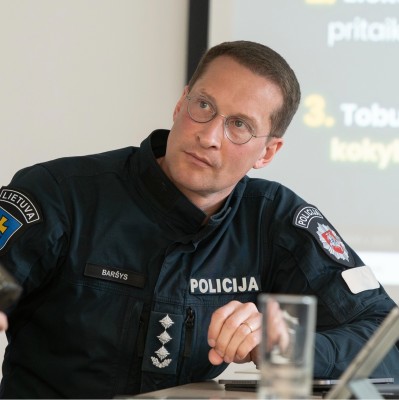
The Case for Lean: Inside the Lithuanian Police

In the Lithuanian Police, where every activity depends on people, Lean Thinking is helping to change the way the organization operates. The challenge is to engage leaders in the transformation, align everyone around a few key priorities and develop the ability to address society's problems proactively, rather than relying solely on reactive measures that increase workloads without solving underlying issues. By adopting a problem-solving approach, the police are discovering how to simplify operations, improve the way work is organized and create greater value for society. This presentation traces their transformation journey and the lessons learned along the way.

Mindaugas Barsys
Text Link
Parallel session
November 13, 2026
09:00
-
09:30
UTC
Who Owns Improvement in the Age of AI?

AI can identify patterns, support analysis and accelerate decision-making. But ownership, learning and continuous improvement must remain firmly in people's hands.
How can organizations harness these technologies without becoming dependent on them? This session examines how Lean connects strategy deployment, visual management, problem-solving and AI into a coherent management system that develops people's capabilities and enables organizations to improve themselves.

Stefano Cocconcelli
Text Link
Parallel session
November 13, 2026
09:00
-
09:30
UTC
Artisanship at Scale: The Real Toyota Lesson

As companies scale, complexity multiplies: quality suffers, decisions slow down, costs rise and customer satisfaction declines. Under pressure to boost short-term results, leaders often turn to financial controls, process reengineering and efficiency programs. Even lean transformations can fall into this trap, overlooking the people who create value. Yet AI cannot replace human expertise and judgment. Toyota offers a different approach: scaling human expertise, not just processes and tools. By developing artisans who master their craft, solve problems intelligently and continuously improve, companies can grow without sacrificing quality, innovation or customer value. Discover why this approach matters more than ever in the age of AI.

Sandrine Olivencia
Text Link
Parallel session
November 13, 2026
09:30
-
10:00
UTC
Engaging Engineers in Strategy Deployment: The Power of Hoshin

How can an organization develop the talents of engineers and highly skilled employees so they contribute to its operations while also building their ability to identify and solve problems across the business? This presentation outlines Moog's journey and what it has accomplished over the past few years. It explains how the Hoshin process was used to involve managers and lead engineers from various divisions in organizational development, so that they take ownership of goals and activities and carry them out throughout the year.

Mindaugas Liutkauskas
Text Link
Main Stage
November 13, 2026
09:30
-
10:00
UTC
When Lean Improvements Make Production Faster than Sales

Discover ARPAL’s transformation journey, from overcoming a four-month order backlog to optimizing sales processes and expanding internationally. Through process mapping, standard work, analytics, and automation, ARPAL reduced sales-script preparation time from 42 hours to just 3 and lowered the refusal rate from 30% to 13%. Today, the company continues its lean transformation by implementing hoshin kanri, aligning strategic objectives with operational improvements and engaging teams in achieving long-term business goals. A practical example of how Lean evolves from operational efficiency into a company-wide management system.

Mykhailo Parpalos
Text Link
Parallel session
November 13, 2026
09:30
-
10:00
UTC
From Pilots to Global Excellence: Scaling the Lean Journey at Coats

How does a global company with operations in more than 40 countries scale Lean effectively while building the capabilities to sustain results? Coats embarked on its lean journey through pilot programs in Indonesia, Mexico, China, Vietnam, and Egypt, learning alongside Lean Institute Brazil and its partners in the Lean Global Network. These pilots are generating practical insights to accelerate the next phase: expanding into ~10-15 additional countries in 2027 and another ~10 in 2028. Beyond improving business performance, the journey is helping to establish the foundations of an Operational Excellence Model to strengthen governance, sustain results, and continuously advance toward excellence.

Pasquale Abruzzese
Farah Zabeen
Text Link
Main Stage
November 13, 2026
10:00
-
10:30
UTC
Beyond Automation: Building Better Systems, Not Just Better Machines

Twelve years as a Production Manager at Toyota and nine years leading a business transformation have taught Chloé a fundamental lesson: technology can only deliver its full potential when built on solid foundations. Through the lens of the Toyota Way, this session will explore how simplification, standardization and strategic thinking can enable automation at scale. More importantly, it shows why the goal shouldn't be simply to automate existing processes, but to build systems that continuously improve performance, develop people and create sustainable value.

Chloé Bouvel
Text Link
Parallel session
November 13, 2026
10:00
-
10:30
UTC
Beyond Ideas: Creating an Innovation Management System

Iveco Brescia is building a structured approach to turn operational challenges into innovation opportunities by connecting people, processes, and technology. This presentation shows how the plant’s management system and Innoveco, its internal innovation lab, work together to address needs on the assembly line, with a concrete example of AI supporting the launch of a new model and the results achieved so far.

Fabio Piccinelli
Luca Damiano
Paolo Gozzoli
Text Link
Main Stage
November 13, 2026
10:30
-
11:00
UTC
Lean, AI, and Transformation: Surviving the Invasion of the Bots

While the headlines scream that the newest generation of large language models (LLMs) are upending jobs, people, processes, and systems across society, if we take a breath and look at the fundamentals of organizations and change, the strengths of being a lean thinker and leader are plain to see. The perils of automating on the basis of just 20% of your enterprise knowledge are significant: Nigel will explain why lean people need to become the detectives that harness the tacit knowledge of "the way things work around here" that delivers real competitive advantage.

Nigel Dalton
Text Link
Parallel session
November 13, 2026
10:30
-
11:00
UTC
The Human Side of Improvement

Every improvement starts with people who choose to learn, grow, and help others succeed. This presentation shows how people development, shared experiences, and a spirit of collaboration as One Team are building the skills, leadership, and engagement that will shape the future of Silgan Dispensing Systems.

Matteo Rosti
Federica Scimè
Text Link
Main Stage
November 13, 2026
11:00
-
11:30
UTC
75% AI Adoption: From Technology to a Culture of Improvement

What does it take to achieve widespread AI adoption, and how can it change the way people envision the future of their organization? Würth Italia will share how a structured approach to AI adoption helped 75% of its 4,000 employees develop the skills and confidence to use LLM-based tools. But adoption was only the beginning. This session explores how the widespread use of AI is encouraging employees to think more ambitiously about future-state processes, with practical examples of how value stream mapping and agentic AI are helping generate ideas to reduce lead-times and drive continuous improvement.

Chiara Dipasquale
Lucia Simonato
Text Link
Paid workshop
November 13, 2026
11:00
-
13:00
UTC
Where Are the Gaps in Your Lean Transformation?

Why do some Lean transformations struggle to progress or sustain their results? In this two-hour interactive workshop, participants will explore the five dimensions of the Lean Transformation Framework (LTF) and reflect on how each one relates to their own journey (of transformation).

The facilitators will introduce common failure modes of a transformation and guide participants through each of the five LTF dimensions. After each dimension, a short individual exercise will help participants connect the concepts to their own situation.

At the end of the workshop, participants will use an online application to conduct a self-diagnosis and identify gaps across the five dimensions of their transformation.

You won’t leave with all the answers! But you will leave with a clearer view of your current situation — and a question to continue exploring: Where should I focus next?

For detailed information about this workshop and requirements, check out the dedicated section at the bottom of the page.

David Brunt
Peter Watkins
David Marriott
Text Link
Paid workshop
November 13, 2026
11:00
-
13:00
UTC
Onde Estão as Lacunas na Sua Transformação Lean?

WORKSHOP IN PORTUGUESE

Porque é quealgumas transformações Lean têm dificuldade em progredir ou em sustentar osresultados alcançados?

Neste workshopinterativo de duas horas, os participantes irão explorar as cinco dimensões doLean Transformation Framework (LTF) e refletir sobre a forma como cada uma serelaciona com o seu próprio percurso de transformação.

Os facilitadoresirão apresentar alguns dos modos de falha mais comuns numa transformação eorientar os participantes na exploração de cada uma das cinco dimensões do LTF.Após cada dimensão, um breve exercício individual permitirá relacionar osconceitos abordados com a realidade de cada participante.

No final doworkshop, os participantes irão utilizar uma aplicação online para realizar umautodiagnóstico e identificar todas as suas lacunas, em cada uma das dimensõesda sua transformação.

Não irá sairdeste workshop com todas as respostas, mas sairá com uma visão mais clara dasua situação atual — e com uma questão para continuar a explorar: Onde devoconcentrar esforços a seguir?

For detailed information about this workshop and requirements, check out the dedicated section at the bottom of the page.

Sergio Caldeirinha
Luis Angeja
Text Link
Parallel session
November 13, 2026
11:00
-
11:30
UTC
The Power of 1,073 Ideas: Lean Transformation at LUKAS

At LUKAS, a Ukrainian food manufacturer, Lean is helping turn everyday production challenges into measurable business results. Viktoriia will present the company's experience in building a culture of continuous improvement through employee engagement, visual management, performance measurement and systematic problem-solving. The results speak for themselves: a 65% increase in croissant production productivity, UAH 24.4 million in annual economic benefits, and 1,073 employee improvement proposals generating a total economic impact of UAH 46.5 million over five years. A practical story of how Lean can turn operational challenges into sustainable improvements and business value.

Victoriia Koroletska
Text Link
Main Stage
November 13, 2026
11:30
-
12:00
UTC
AI as a Lean Assistant, Not a Replacement

How can AI support continuous improvement without taking over the thinking, decisions and problem-solving that make Lean effective? This session explores how the Continuous Improvement Office at EHA Clinics is integrating AI into its existing lean processes, from turning gemba walk notes into follow-up actions to drafting A3s and project charters and supporting consistent project management standards. By leaving verification, problem ownership and decision-making firmly in human hands, the team is reducing administrative work and freeing up more time for coaching and improvement at the gemba. Drawing on practical examples and comparisons between human and AI-generated outputs, the presentation explores where AI adds value, where it falls short and why knowing what not to automate is just as important as knowing what to automate.

Fatima Abubakar
Text Link
Parallel session
November 13, 2026
11:30
-
12:00
UTC
Ask the Coach - Live Q&A

Bring your lean questions to this interactive session with Karen Gaudet of the Lean Enterprise Institute. With several years of hands-on experience supporting transformations across industries, Karen will share practical insights and straight answers to real-world challenges — live and unfiltered.

Karen Gaudet
Text Link
Main Stage
November 13, 2026
12:00
-
12:30
UTC
Lean and AI: The Questions We Need to Be Asking

AI is rapidly changing how organizations work, make decisions, and solve problems. But what does that mean for Lean? In this panel discussion, three Lean Tech Voices columnists tackle some of the most pressing questions at the intersection of Lean and AI. From the changing role of people and leaders to problem-solving, continuous improvement and the risks of automating waste, the conversation will explore where AI can strengthen Lean — and where it might challenge some of its fundamental assumptions. Join this open conversation and learn what lean practitioners need to be thinking about as AI reshapes the world of work.

Sandrine Olivencia
Eivind Reke
Fabrice Bernhard
Text Link
Parallel session
November 13, 2026
12:30
-
13:00
UTC
When AI Takes Over Routine Work: Rediscovering the Human Role

As AI takes over routine tasks, does it make people less valuable, or free them to focus on what truly matters? At Notino, automating everyday activities has become the starting point for a deeper transformation, unfolding in three stages: automating tasks, redesigning processes and redefining people's roles within the organization. But the challenge goes beyond technology. As AI changes the way work is done, people need to develop the ability to adapt, learn, collaborate and embrace uncertainty. Notino's experience highlights how organizations can help employees move beyond routine work and develop the confidence and flexibility to thrive in an environment of constant change.

Michal Černošek
Text Link
Parallel session
November 13, 2026
12:30
-
13.00
UTC
Daily Management: Lessons from 100+ Companies

After more than five years of helping over 100 companies implement Daily Management, Lean Institute Brasil reflects on the experience, sharing key lessons learned, challenges encountered and insights gained along the way.

José Roberto Ferro
Daniel Felipe de Oliveira
Text Link
Parallel session
November 13, 2026
13:00
-
13:30
UTC
From Data to Design: When Daily Management Feeds Lean Product and Process Development

Galip’s interim General Manager assignment at furniture company ByKepi began with an unglamorous job: collecting, organizing and cleaning the data. The company then introduced daily management so decisions rested on what the shop floor produced each day rather than on opinion. Simplifying the range and analyzing costs on the priority product family cut SKUs nearly in half and sharply reduced material cost and labor time, while improvements across planning, routings and design brought lead time down from three months to 30 days and cut quality problems by 40%. Meanwhile, competitor benchmarking and product-market fit work opened up the design side: new products developed through front-loading and set-based concurrent engineering debuted at Milan Design Week, drawing strong customer and partner interest. This session shows how daily management data and LPPD can support eachf other.

Galip Arbak
Text Link
Main Stage
November 13, 2026
13:00
-
13:30
UTC
What AI Will Never Do

Genchi genbutsu means creating a consensus on how things work and going ever closer towards monozukuri, the detail of work and physical processes: what really happens, what really is a problem, how can we really improve customer usage and make work easier for employees. In order to build consensus on capabilities gaps: competence is both being autonomous on resolving problems and having the leadership to access the experts when needed and organize the problem solving. Hitozukuri starts by creating a consensus on what problems we know how to solve, what problems we must learn to solve, and what problems the social body tries to avoid solving as culture resists evolution, in order to respond to our monozukuri challenges. To support both processes, we need kotozukuri: creating an environment of focusing on what matters and how to make it happen, through visualization, imagery, narrative and using tools. The collective tempo of work on what matters is what makes us come together as a fighting organization to solve our problems for customers and for society at large, profitably and collectively.

Michael Ballé
Text Link
Main Stage
November 13, 2026
13:30
-
14:00
UTC
Closing LGC 2026

In the closing, we reflect on the key learnings from the previous 24 hours.

Roberto Priolo
Christopher Thompson
John Shook

Keynote speakers

More info coming soon.

Vickie Pisowicz
Founder - Imagining Excellence |
Founder - Imagining Excellence
Victoriia Koroletska
Deputy Director for Operational Efficiency Development - Lukas confectionery company, Ukraine |
Deputy Director for Operational Efficiency Development - Lukas confectionery company, Ukraine
Yurii Dobronravin
CEO and Co-founder - Logika Design Bureau and Warbirds (part of BPU Group, Ukraine |
CEO and Co-founder - Logika Design Bureau and Warbirds (part of BPU Group, Ukraine
Zach Kauffman
Director of Continuous Improvement - Viwinco Windows |
Director of Continuous Improvement - Viwinco Windows
Zdzisław Konior
General Manager of Production, Corporate Training & TPS - Toyota Motor Manufacturing Poland |
General Manager of Production, Corporate Training & TPS - Toyota Motor Manufacturing Poland
Zehra Tanhan
Information Technology Product Owner - Brisa Bridgestone Sabancı, Turkey |
Information Technology Product Owner - Brisa Bridgestone Sabancı, Turkey
Zul Fajri
Process Engineer - Vale Indonesia |
Process Engineer - Vale Indonesia

2025 presentations can be watched here

2024 presentations can be watched here

2023 presentations can be watched here